Event submissions
Published
 10.3390/engproc2026163039 (registering DOI)
This submission belongs to the session S4. Sensors and Artificial Intelligence of the event The 13th International Electronic Conference on Sensors and Applications
Published date
13 Nov, 2026
Academic Editor
 Francisco Falcone
Citation
Yeraldin Velez-Galvis, Alejandra Cano-Paniagua, Esteban Gonzalez-Valencia, Machine Learning-Based Virtual Sensors for Early Detection of Critical Water Pollutants in the Cauca River, Colombia, in Proceedings of The 13th International Electronic Conference on Sensors and Applications, 18 November–20 November 2026, MDPI: Basel, Switzerland, doi: 10.3390/engproc2026163039
Share
Email
Facebook
Twitter
LinkedIn
Machine Learning-Based Virtual Sensors for Early Detection of Critical Water Pollutants in the Cauca River, Colombia

Yeraldin Velez-Galvis 1
Alejandra Cano-Paniagua 2
Esteban Gonzalez-Valencia 3
1. Department of Systems, Engineering Faculty, Institución Universitaria ITM, Medellin, Colombia
2. Faculty of Agricultural Sciences, Universidad de Antioquia, Medellin, Colombia
3. Department of Electronics and Telecommunications, Engineering Faculty, Institución Universitaria ITM, Medellin, Colombia
Abstract
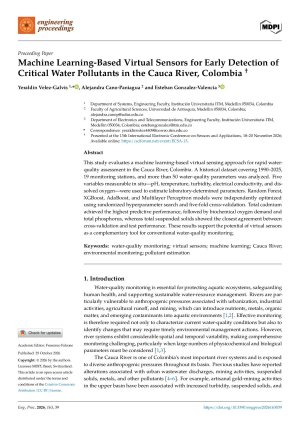
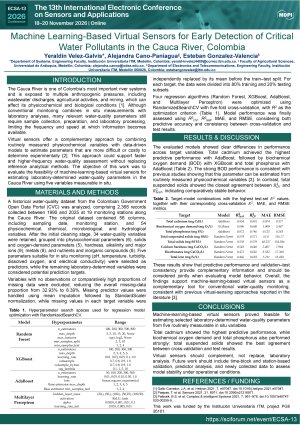
Introduction: Continuous monitoring in important water sources such as the Cauca River, the second largest in Colombia, is essential for environmental management. However, the extended measurement times associated with laboratory analyses limit real-time decision-making. Machine learning-based virtual sensors are proposed as early indicators of emergence of critical pollutants, overcoming the limitations of traditional laboratory methods.
Methods: This study analyzes a historical database (1990–2025) from 19 sampling stations along the Cauca River and includes more than 50 physicochemical, microbiological, and biological parameters. Physical measurements taken from sensors in situ (pH, temperature, turbidity, electrical conductivity, and dissolved oxygen) were selected as predictor variables, while variables measured in laboratories were selected as targets. Data was normalized using RobustScaler to reduce the effects of outliers, and mean imputation was used to handle missing values. Four machine learning models were trained, AdaBoost, XGBoost, Multilayer Perceptron and Random Forest, and results were compared using 5-fold cross-validation, while hyperparameter optimization was implemented using Random Search.
Results: Algorithms captured the nonlinear relationships within the river system. AdaBoost presents the highest coefficients of determination for total cadmium (R² of 0.801) and total phosphorus (R² = 0.746), while Random Forest exhibits a good performance for total iron (R² = 0.683) and calcium hardness (R² = 0.639).
Conclusions: By combining robust data scaling with ensemble learning models, a stable virtual sensor for water quality monitoring was developed, an approach that enhances the capabilities of existing physical sensor networks by transforming them into intelligent monitoring stations with the potential of estimating pollutant and heavy metal concentrations in real time. Early detection of phosphorus, cadmium, and iron may streamline the implementation of mitigation strategies, reducing their potential impact on the ecosystem and the health of riverside communities. Therefore, this machine learning-based virtual sensor contributes to establishing an efficient environmental early-warning system.
Keywords
Virtual sensor
Machine learning
Water quality monitoring
Ensemble learning
Manuscript
Sciforum-192302engproc-163-00039.pdf
Poster
Póster_RíoCauca.pdf
Real-Time EEG Processing on Embedded Hardware for Brain–Computer Interfaces
DESIGN AND DEVELOPMENT OF A GLASS-MOUNTED ULTRASONIC OBSTACLE DETECTION SYSTEM FOR VISUALLY IMPAIRED INDIVIDUALS