Event submissions
Published
 10.3390/engproc2026163041 (registering DOI)
This submission belongs to the session S4. Sensors and Artificial Intelligence of the event The 13th International Electronic Conference on Sensors and Applications
Published date
13 Nov, 2026
Academic Editor
 Francisco Falcone
Citation
Bem Gumapac, Uncertainty-Aware Cross-Dataset Reliability Screening of Machine Learning Models for Drift-Affected Gas Sensor Arrays Under Missing and Corrupted Channels, in Proceedings of The 13th International Electronic Conference on Sensors and Applications, 18 November–20 November 2026, MDPI: Basel, Switzerland, doi: 10.3390/engproc2026163041
Share
Email
Facebook
Twitter
LinkedIn
Uncertainty-Aware Cross-Dataset Reliability Screening of Machine Learning Models for Drift-Affected Gas Sensor Arrays Under Missing and Corrupted Channels

Bem Gumapac 1
1. Computer Engineering Department, College of Engineering, Architecture and Industrial Design, Bohol Island State University, Tagbilaran City 6300, Philippines
Abstract
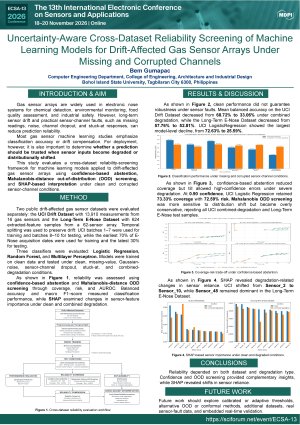
An uncertainty-aware reliability screening pipeline was developed for machine learning models applied to drift-affected gas sensor arrays under missing and corrupted sensor-channel conditions. The pipeline consists of dataset-specific preprocessing, model training, simulated sensor degradation, confidence-based abstention, coverage-risk evaluation, AUROC analysis, and SHAP-based sensor-feature interpretation. Two public datasets were used: the UCI Gas Sensor Array Drift Dataset and the Long-Term E-Nose Dataset. Logistic Regression, Random Forest, and Multilayer Perceptron were evaluated under five degradation scenarios: missing values, Gaussian noise, sensor-channel dropout, stuck-at-faults, and combined degradation. Results showed that clean classification performance did not guarantee robustness. On the UCI Drift Dataset, Logistic Regression achieved the highest clean balanced accuracy of 73.36%, but decreased to 25.57% under combined degradation. At the dataset level, mean balanced accuracy decreased from 68.96% to 33.05% for the UCI Drift Dataset and from 57.98% to 52.81% for the Long-Term E-Nose Dataset. At a confidence level threshold of 0.90, Logistic Regression on the UCI Drift Dataset still produced a high accepted-prediction risk of 72.39% under combined degradation, indicating overconfidence despite corrupted inputs. SHAP analysis showed that the dominant UCI sensor group shifted from Sensor_2 to Sensor_10, while Sensor_48 remained dominant in the Long-Term E-Nose Dataset. Compared with conventional gas sensor drift studies that mainly emphasized classification accuracy or drift compensation, this work contributes a cross-dataset reliability-oriented evaluation protocol that combines degradation testing, abstention-based screening, and explainable sensor-feature analysis for more practical assessment of electronic nose models.
Keywords
gas sensor array
electronic nose
sensor drift
machine learning
relaibility screening
confidence-based abstention
sensor degradation
SHAP
Manuscript
Sciforum-188433engproc-163-00041.pdf
Poster
ECSA13_Poster_Revised.pdf
DESIGN AND DEVELOPMENT OF A GLASS-MOUNTED ULTRASONIC OBSTACLE DETECTION SYSTEM FOR VISUALLY IMPAIRED INDIVIDUALS
Synthetic-to-Real Transfer with a Causal Temporal Convolutional Network for Site-Calibrated Virtual Heat-Flux Sensing