Event submissions
Published
 10.3390/engproc2026163046 (registering DOI)
This submission belongs to the session S4. Sensors and Artificial Intelligence of the event The 13th International Electronic Conference on Sensors and Applications
Published date
13 Nov, 2026
Academic Editor
 Francisco Falcone
Citation
Pavel Kyurkchiev, Anton Iliev, Sensor-Augmented Retrieval of System Dynamics Model Segments for Resource-Constrained Environments, in Proceedings of The 13th International Electronic Conference on Sensors and Applications, 18 November–20 November 2026, MDPI: Basel, Switzerland, doi: 10.3390/engproc2026163046
Share
Email
Facebook
Twitter
LinkedIn
Sensor-Augmented Retrieval of System Dynamics Model Segments for Resource-Constrained Environments

Pavel Kyurkchiev 1

Anton Iliev 1,2
1. Faculty of Mathematics and Informatics, University of Plovdiv “Paisii Hilendarski”, 24, Tzar Asen Str., 4000 Plovdiv, Bulgaria
2. Centre of Excellence in Informatics and Information and Communication Technologies, 1113 Sofia, Bulgaria
Abstract
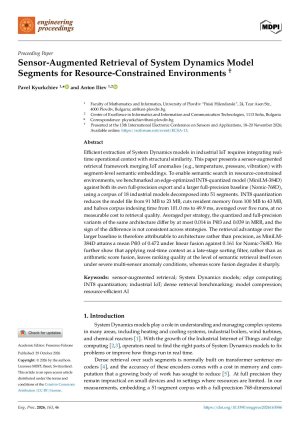
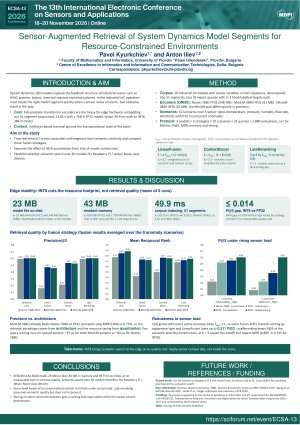
Introduction: Efficient extraction of System Dynamics models in industrial IoT environments requires not only structural similarity but also the integration of real-time operational context. This paper presents a sensor-enhanced extraction framework that merges the context of real-time IoT anomalies—such as temperature, pressure, and vibration—with segment-level semantic representations (embeddings). The main focus is on providing semantic search for resource-constrained environments by using optimized INT8-quantized embedding models.
Methods: We conducted extensive benchmarks using a new corpus of 18 industrial engineering models decomposed into 51 typed segments. To assess the feasibility for implementation under resource constraints, we compared the performance and resource consumption of a full-precision model (Nomic-768D, 11.7 GB memory) against an INT8-quantized model (MiniLM-384D, 23 MB memory) on a local workstation.
Results: Experimental results show that the quantized model not only reduces memory consumption by 510 times, but also achieves +14% higher Mean Reciprocal Rank (MRR = 0.885 vs. 0.774) with a significant reduction in latency from 22,244 ms to 17 ms. Furthermore, the study confirms that under high sensor bias (loads), such as thermal anomalies, the LateReranking fusion strategy effectively recovers the accuracy (P@3) from 0.219 to 0.594.
Conclusions: These findings suggest that the combination of lightweight quantized models and context-aware reranking is a viable path to implementing reliable semantic search capabilities in industrial IoT ecosystems where hardware resources are limited.
Keywords
Sensor-Augmented Retrieval
System Dynamics Models
Edge Computing
INT8 Quan-tization
Industrial IoT
Anomaly-Aware Ranking
Resource-Efficient AI
Manuscript
Sciforum-185898engproc-163-00046.pdf
Poster
ECSA-13_poster_Kyurkchiev_Iliev.pdf
Numerical Analysis of Bubble Interference on Transmembrane Potential and Electroporation Uniformity in Pulsed Electric Field Systems
Comparative Analysis of Metal-Oxide Thin Films on Planar Coverslip Waveguides for Low-Cost Lossy Mode Resonance Sensing