Event submissions
Published
 10.3390/engproc2026163047 (registering DOI)
This submission belongs to the session S2. Physical Sensors of the event The 13th International Electronic Conference on Sensors and Applications
Published date
13 Nov, 2026
Academic Editor
 Jean-Marc Laheurte
Citation
Esteban Gonzalez-Valencia, Erick Reyes-Vera, Mariana Lopera-Obando, Jose Carlos Vergara-Mauris, Comparative Analysis of Metal-Oxide Thin Films on Planar Coverslip Waveguides for Low-Cost Lossy Mode Resonance Sensing, in Proceedings of The 13th International Electronic Conference on Sensors and Applications, 18 November–20 November 2026, MDPI: Basel, Switzerland, doi: 10.3390/engproc2026163047
Share
Email
Facebook
Twitter
LinkedIn
Comparative Analysis of Metal-Oxide Thin Films on Planar Coverslip Waveguides for Low-Cost Lossy Mode Resonance Sensing

Esteban Gonzalez-Valencia 1

Erick Reyes-Vera 1
Mariana Lopera-Obando 1
Jose Carlos Vergara-Mauris 1
1. Department of Electronics and Telecommunications, Institucion Universitaria ITM, Medellín, Colombia.
Abstract
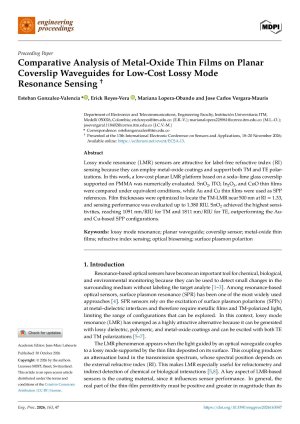
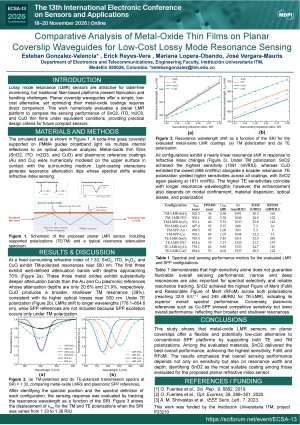
Introduction: Lossy mode resonance (LMR) sensors offer high sensitivity and support both TM and TE polarizations for label-free refractive index monitoring. However, most designs rely on complex optical fibers. This work proposes and numerically assesses a low-cost planar waveguide configuration using a standard glass coverslip coated with thin films as a compact sensor for aqueous and biological media.
Methods: The platform was modeled in FIMMWAVE/FIMMPROP using a soda-lime glass coverslip waveguide on a PMMA substrate. Five materials (SnO₂, ITO, In₂O₃, CuO, and Si) were evaluated, and the film thicknesses were optimized to locate the TM and TE resonances near 500 nm at a surrounding refractive index (SRI) of 1.333 RIU. The response was analyzed by varying the SRI from 1.330 to 1.380 RIU to calculate sensitivities for TM and TE polarizations.
Results: The configuration successfully supported LMR generation for all evaluated thin films with clear resonance shifts. For SnO₂, the sensor achieved a sensitivity of 1091 nm/RIU for the TM polarization and 1811 nm/RIU for the TE polarization. ITO exhibited sensitivities of 1046 nm/RIU (TM) and 1520 nm/RIU (TE), while In₂O₃ showed responses of 1033 nm/RIU (TM) and 1513 nm/RIU (TE). For CuO, the platform reached 668 nm/RIU for the TM polarization and 1537 nm/RIU for the TE polarization. Finally, Si demonstrated a TM sensitivity of 669 nm/RIU, while its TE resonance was omitted as it shifted into the deep infrared region. Across all materials, TE resonances yielded higher overall sensitivities due to enhanced evanescent field interactions at longer operating wavelengths.
Conclusions: Metal-oxide-coated coverslips are a promising low-cost platform for LMR refractive index sensing. Specifically, SnO₂ is the most suitable material due to its superior sensitivity and well-defined resonances. This planar configuration provides a simple, scalable route toward compact optical sensors for real-time chemical and biological monitoring in aqueous environments.
Keywords
Lossy mode resonance
planar waveguide
metal-oxide thin films
refractive index sensing
optical biosensing
aqueous media
low-cost optical sensors
Manuscript
Sciforum-192556engproc-163-00047.pdf
Poster
Poster Sciforum-192556.pdf
Sensor-Augmented Retrieval of System Dynamics Model Segments for Resource-Constrained Environments
Interpretable Machine Learning for PM2.5 Forecasting Using a Long-Term IoT Environmental Dataset in Tropical Thailand