Event submissions
Published
 10.3390/engproc2026163049 (registering DOI)
This submission belongs to the session S6. Electronic Sensors, Devices, and Systems of the event The 13th International Electronic Conference on Sensors and Applications
Published date
13 Nov, 2026
Academic Editor
 Jean-Marc Laheurte
Citation
Decha Wongpatsa, Kritphon Phanrattanachai, Siriwat Ninlawat, Phatcharanat Saeng-On, Niwat Angkawisittpan, Somchat Sonasang, Ravee Phomloungsri, Nondestructive Quality Evaluation of Nakhon Phanom Lychee (NP.1) Using Parallel Coupled Line Microstrip via Isolation Loss Parameter Analysis, in Proceedings of The 13th International Electronic Conference on Sensors and Applications, 18 November–20 November 2026, MDPI: Basel, Switzerland, doi: 10.3390/engproc2026163049
Share
Email
Facebook
Twitter
LinkedIn
Nondestructive Quality Evaluation of Nakhon Phanom Lychee (NP.1) Using Parallel Coupled Line Microstrip via Isolation Loss Parameter Analysis

Decha Wongpatsa 1

Kritphon Phanrattanachai 2
Siriwat Ninlawat 3
Phatcharanat Saeng-On 4
Niwat Angkawisittpan 5

Somchat Sonasang 6
Ravee Phomloungsri 7
1. Interdisciplinary Studies Program, Faculty of Agriculture and Technology, Nakhon Phanom University, Nakhon Phanom 48000, Thailand
2. Faculty of Agricultural and Industrial Technology, Phetchabun Rajabhat University, Phetchabun
67000, Thailand
3. Department of Electrical Technology Faculty of Industrial Technology, Nakhon Phanom University Nakhon Phanom 48000, Thailand
4. Department of Electronics and Intelligent Robotics Engineering, Faculty of Industrial Technology,
Nakhon Phanom University, Nakhon Phanom 48000, Thailand
5. Research Unit for Electrical and Computer Engineering,
Faculty of Engineering, Mahasarakham University, Maha Sarakham 44150, Thailand
6. Electrical Elements and Wireless Devices Unit (EEWDU)
Faculty Industrial Technology
Nakhon Phanom University, Nakhon Phanom 48000, Thailand
7. Department of Computer and Communication Engineering, Faculty of Technology and Engineering
Udon Thani Rajabhat University, Udon Thani, 41000, Thailand
Abstract
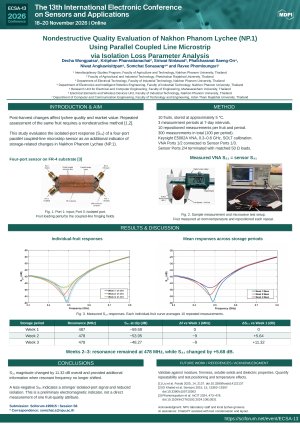
This study investigates the isolated-port response of a four-port parallel coupled-line microstrip structure as a nondestructive microwave indicator for monitoring storage-related changes in Nakhon Phanom Lychee (NP.1). The motivation is to explore the use of the nominally isolated port, represented by S31, as an additional sensing feature beyond conventional reflection or forward-transmission responses. Ten fruits were stored under refrigerated conditions and evaluated at 7-day intervals over three storage periods. Each fruit was measured ten times at room temperature using a two-port vector network analyzer over 0.3–0.8 GHz. In the adopted measurement configuration, the measured VNA S21 response corresponded to the isolated-port parameter S31 of the four-port sensor. The mean resonant frequency decreased from 487 MHz in Week 1 to 478 MHz in Weeks 2 and 3. The S31 magnitude at the resonant dip became progressively less negative, changing from −59.59 dB to −53.95 dB and −48.27 dB, corresponding to a total magnitude change of 11.32 dB. Although the resonant frequency did not distinguish Weeks 2 and 3, the isolation magnitude remained different between these periods. The measured response is consistent with storage-related changes in the effective electromagnetic properties of the fruit. These preliminary results support the feasibility of using isolated-port magnitude as an additional microwave feature for nondestructive lychee monitoring and provide a basis for future correlation with physicochemical and dielectric quality indicators.
Keywords
Parallel coupled line microstrip
Isolation loss
Transmission coefficient
Nondestructive testing
Lychee NP.1 characterization
Dielectric loss tangent
Manuscript
Sciforum-195915engproc-163-00049-v2.pdf
Poster
ECSA13_Lychee_Poster_Final.pdf
Interpretable Machine Learning for PM2.5 Forecasting Using a Long-Term IoT Environmental Dataset in Tropical Thailand
Classification of Grinding Wheel Cutting Ability During Dressing via Acoustic Emission and Neural Network