Event submissions
Published
 10.3390/engproc2026163051 (registering DOI)
This submission belongs to the session S3. Sensor Networks, IoT, Smart Cities and Health Monitoring of the event The 13th International Electronic Conference on Sensors and Applications
Published date
13 Nov, 2026
Academic Editor
 Francisco Falcone
Citation
Renan de Oliveira Alves Takeuchi, Matheus Henrique Pereira, Igor Henrique Santos Coelho de Miranda, Wenderson Nascimento Lopes, Paulo Roberto Aguiar, Experimental Evaluation of PZT Sensors under Pencil Lead Break Excitation in CFRP and Aluminum Plates for SHM Applications, in Proceedings of The 13th International Electronic Conference on Sensors and Applications, 18 November–20 November 2026, MDPI: Basel, Switzerland, doi: 10.3390/engproc2026163051
Share
Email
Facebook
Twitter
LinkedIn
Experimental Evaluation of PZT Sensors under Pencil Lead Break Excitation in CFRP and Aluminum Plates for SHM Applications

Renan de Oliveira Alves Takeuchi 1,2
Matheus Henrique Pereira 2
Igor Henrique Santos Coelho de Miranda 2
Wenderson Nascimento Lopes 1
Paulo Roberto Aguiar 2
1. Department of Industrial Control and Processes, Paraná Federal Institute of Education (IFPR), Jacarezinho 86400-000, Brazil
2. Department of Electrical Engineering, Faculty of Engineering, São Paulo State University (UNESP), Bauru, São Paulo, 17033-360, Brazil.
Abstract
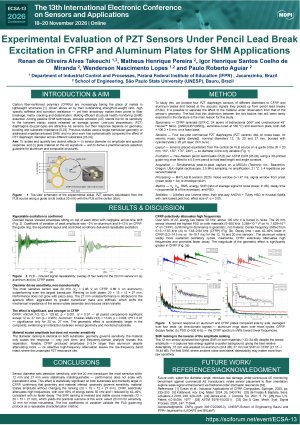
Composite materials have been progressively replacing metallic materials in high-performance lightweight structures, such as those found in aerospace, automotive, and wind turbine components. Such applications also require high safety and efficiency. Small, lightweight piezoelectric transducers have been the subject of studies for structural health monitoring (SHM) because they are minimally invasive to the monitored structure. However, there has been little exploration of the performance comparison of PZT diaphragm sensors, commonly found in buzzers, for SHM in composite materials. In this study, we present an experimental analysis of PZT diaphragm sensors (with diameters of 12, 15, 20, and 27 mm) attached with cyanoacrylate adhesive to carbon fiber-reinforced polymer (CFRP) and aluminum plates measuring 448 × 106.3 × 5.5 mm, supported on a foam base to minimize external vibrations. For acoustic emission excitation, the Pencil Lead Break (PLB) method was employed at a fixed distance of 20 mm from each sensor, with three repetitions. A digital oscilloscope with a sampling frequency of 2.5 MHz was used to acquire the signals, and the ambient temperature was monitored and maintained at a constant 21°C. The signals show a strong dependence on the material properties of the plates and the dimensions of the sensors. The CFRP exhibited anisotropic behavior due to its attenuation, predominantly in the range of 0 to 100 kHz, while the aluminum plate, more isotropic, showing responses with greater propagation in terms of oscillation. There is similarity in the frequency band among the sensors and high sensitivity to transients, as they clearly capture the event. Furthermore, it is possible to determine the location of the event when signals are obtained at different distances. This systematic comparison provides practical guidelines for sensor selection, supporting the development of more affordable and technically feasible monitoring solutions for lightweight metal and composite structures.
Keywords
piezoelectric sensors
acoustic emission
pencil lead break
structural health monitoring
cost-effectiveness
Manuscript
Sciforum-196856engproc-163-00051-v2.pdf
Poster
Poster_PZT.pdf
Classification of Grinding Wheel Cutting Ability During Dressing via Acoustic Emission and Neural Network
Design and Performance Evaluation of a 5G-Enabled Smart City IoT Network with Multi-Access Edge Computing Using a Simu5G Network Simulator