Event submissions
Published
 10.3390/engproc2026163055 (registering DOI)
This submission belongs to the session S8. Robotics, Sensors, and Industry 4.0 of the event The 13th International Electronic Conference on Sensors and Applications
Published date
13 Nov, 2026
Academic Editor
 Francisco Falcone
Citation
Vitória Marchioni Pereira da Cunha, Clara Teresa De Souza Ramos, Guilherme Brasil Pintarelli, Lucas Bertinetti Lopes, Daniela Ota Hisayasu Suzuki, Evaluation of Potato Tissue Hydration and PEF Response Through Low‑Voltage Electrical Monitoring, in Proceedings of The 13th International Electronic Conference on Sensors and Applications, 18 November–20 November 2026, MDPI: Basel, Switzerland, doi: 10.3390/engproc2026163055
Share
Email
Facebook
Twitter
LinkedIn
Evaluation of Potato Tissue Hydration and PEF Response Through Low‑Voltage Electrical Monitoring

Vitória Marchioni Pereira da Cunha 1
Clara Teresa De Souza Ramos 1

Guilherme Brasil Pintarelli 2
Lucas Bertinetti Lopes 3
Daniela Ota Hisayasu Suzuki 1
1. Instituto de Engenharia Biomédica, Federal University of Santa Catarina, Florianópolis, SC, Brazil
2. Department of Control, Automation and Computer Engineering, Federal University of Santa Catarina, Blumenau, SC, Brazil
3. Department of Computer Engineering, Federal University of Santa Catarina, Araranguá 88906-072, SC, Brazil
Abstract
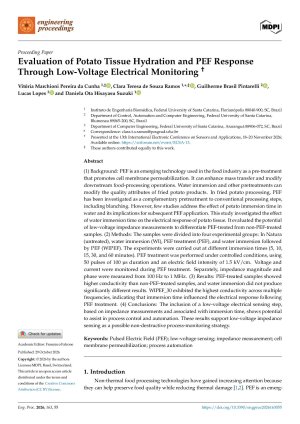
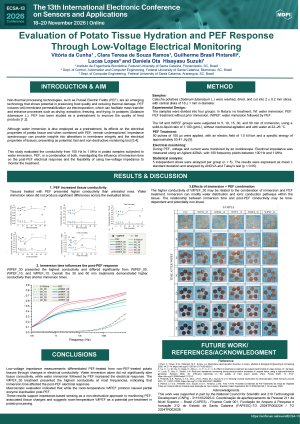
INTRODUCTION: PEF is an emerging technology used in the food industry as a pre‑treatment that promotes cell membrane permeabilization. It is often used to improve the nutritional and sensory quality and microbial inactivation. Water soaking and other pre‑treatments can lower acrylamide and alter texture, crispness, and oil uptake in fried potatoes. In fried potato processing, PEF has been used as an alternative or complementary non‑thermal pre‑treatment to conventional thermal steps such as blanching. However, there are few studies addressing the effect of potato immersion time in water and its implications for subsequent PEF application. This work aims to investigate the effect of water immersion time on potato tissue and to propose a preliminary low‑voltage electrical sensing step to assess tissue viability for PEF. METHODS: The samples were divided into four experimental groups: untreated (UT), water immersion (WI), PEF treatment (PEF), and water immersion followed by PEF (WIPEF). The experiments were carried out at different immersion times (5, 10, 15, 30, and 60 minutes). PEF treatment was performed under controlled conditions, using 50 pulses of 100 µs duration and an electric field intensity of 1.5 kV/cm. System electrical parameters: voltage, current, and conductivity were monitored in order to evaluate changes associated with the tissue’s structural state. RESULTS: The measurement of the electrical parameters has potential to indicate changes in ion leaching and conductivity caused by the pre‑treatments. Current and conductivity measurements allow to characterize the structural state of the potato, indicating its level of cellular permeabilization prior to PEF application. CONCLUSIONS: The inclusion of a low‑voltage electrical sensing step, based on impedance measurement and associated with immersion time, shows potential to assist in process control and automation. This approach makes it possible to evaluate whether the tissue is ready to proceed to PEF treatment.
Keywords
Pulsed Electric Field (PEF)
Low-Voltage Sensing
Impedance Measurement
Cell Membrane Permeabilization
Process Automation
Manuscript
Sciforum-192084engproc-163-00055.pdf
Poster
POSTER - Evaluation of Potato Tissue Hydration and PEF Response Through Low‑Voltage Electrical Monitoring.pdf
Low-Cost Hybrid Pyranometer with Machine Learning-Enhanced Solar Irradiance Sensing
SeatID: Design, Functional Characterization, and Preliminary Computational Validation of a Piezoresistive Smart Cushion Toward Continuous Biometric Authentication in Virtual Examinations