Event submissions
Published
 10.3390/engproc2026163056 (registering DOI)
This submission belongs to the session S4. Sensors and Artificial Intelligence of the event The 13th International Electronic Conference on Sensors and Applications
Published date
13 Nov, 2026
Academic Editor
 Francisco Falcone
Citation
Alex Fabián Suárez de la Rosa, Lina Mayerly Cruz Parra, Luis Carlos Álvarez Vélez, SeatID: Design, Functional Characterization, and Preliminary Computational Validation of a Piezoresistive Smart Cushion Toward Continuous Biometric Authentication in Virtual Examinations, in Proceedings of The 13th International Electronic Conference on Sensors and Applications, 18 November–20 November 2026, MDPI: Basel, Switzerland, doi: 10.3390/engproc2026163056
Share
Email
Facebook
Twitter
LinkedIn
SeatID: Design, Functional Characterization, and Preliminary Computational Validation of a Piezoresistive Smart Cushion Toward Continuous Biometric Authentication in Virtual Examinations

Alex Fabián Suárez de la Rosa 1
Lina Mayerly Cruz Parra 2
Luis Carlos Álvarez Vélez 1
1. Biomedical Metrology and Maintenance Research Group, Institucion Universitaria ITM, Medellin, Colombia.
2. Faculty of Exact and Applied Sciences, Institución Universitaria ITM, Medellín, Antioquia, Colombia
Abstract
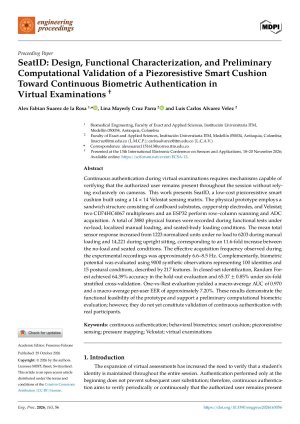
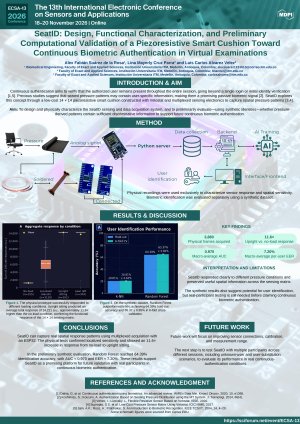
Introduction: Verifying student identity during online examinations is still a challenge for educational institutions. Traditional methods such as webcams and human proctoring may not detect situations in which a different person replaces the student outside the camera's field of view. To address this problem, we developed SeatID, a smart cushion that uses pressure and motion information to continuously verify the identity of the user during an examination. If a change of user is detected, the system can automatically block the session.
Methods: SeatID uses an ESP32 microcontroller connected to a 14×14 Velostat pressure sensor matrix and multiplexers to record the pressure pattern produced while sitting. User identification is based on individual seating characteristics, including body weight distribution and anatomical differences such as the distance between the ischial tuberosities. An Inertial Measurement Unit (IMU) was also included to monitor movement and detect unusual behavior that could indicate a user replacement attempt. Sensor data were transmitted via Wi-Fi to a Python server for processing. User classification was performed using the k-Nearest Neighbors (k-NN) algorithm. The model was trained with simulated data and later tested using the physical prototype.
Results: A dataset of 1,800 records was collected under controlled conditions. Using 10-fold cross-validation, the k-NN classifier achieved an average accuracy of 99.94% with a standard deviation of ±0.17% across 360 test samples. The system also obtained an Equal Error Rate (EER) of 0.00%, indicating effective discrimination between authorized users and impostors.
Conclusions: The proposed system successfully combined pressure and motion data to provide continuous user authentication. The developed prototype achieved reliable performance under controlled conditions and detected user replacement attempts in real time.
Keywords
Continuous authentication
Hybrid biometrics
Pressure sensing
Piezoresistive sensor matrix
Inertial Measurement Unit (IMU)
User authentication
Impersonation detection
k-Nearest Neighbors (k-NN)
Smart cushion
Biomechanical signatures
Manuscript
Sciforum-192337engproc-163-00056.pdf
Poster
Poster Sensors Conference.pdf
Evaluation of Potato Tissue Hydration and PEF Response Through Low‑Voltage Electrical Monitoring
In Situ Process Characterization and State Assessment in FFF Using Pitch-Catch Techniques