Event submissions
Published
 10.3390/engproc2026163058 (registering DOI)
This submission belongs to the session S6. Electronic Sensors, Devices, and Systems of the event The 13th International Electronic Conference on Sensors and Applications
Published date
13 Nov, 2026
Academic Editor
 Jean-Marc Laheurte
Citation
Oscar Andrés Tobar Rosero, Juan Miguel Guarnizo londoño, Johan Orlando Moreno Castro, Gabriel Jaime Sánchez Zuluaga, Edwin Alexander Moncada Acevedo, Development of a Sensorized Platform for Monitoring and Control of a Low-Cost 3D-Printed Green Hydrogen Electrolyzer Powered by Photovoltaic Energy, in Proceedings of The 13th International Electronic Conference on Sensors and Applications, 18 November–20 November 2026, MDPI: Basel, Switzerland, doi: 10.3390/engproc2026163058
Share
Email
Facebook
Twitter
LinkedIn
Development of a Sensorized Platform for Monitoring and Control of a Low-Cost 3D-Printed Green Hydrogen Electrolyzer Powered by Photovoltaic Energy

Oscar Andrés Tobar Rosero 1,2

Juan Miguel Guarnizo londoño 1
Johan Orlando Moreno Castro 1
Gabriel Jaime Sánchez Zuluaga 1
Edwin Alexander Moncada Acevedo 1
1. Facultad de Ingeniería, Institución Universitaria de Envigado—IUE, Carrera 27B # 39A Sur-57, Envigado 055420, Colombia
2. Departamento de Energía Eléctrica y Automática, Facultad de Minas, Universidad Nacional de Colombia Sede Medellín, Carrera 80 No. 65-223, Robledo, Medellín 050034, Colombia
Abstract
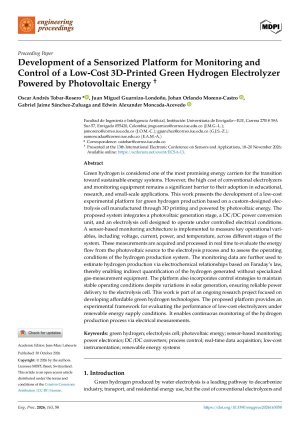
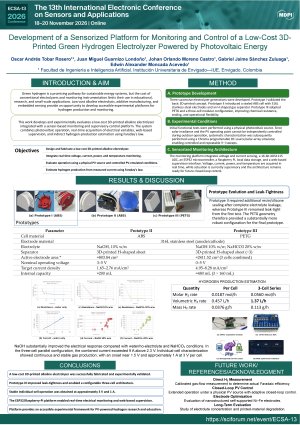
Green hydrogen is considered one of the most promising energy carriers for the transition toward sustainable energy systems. However, the high cost of conventional electrolyzers and monitoring equipment remains a significant barrier to their adoption in educational, research, and small-scale applications. This work presents the development of a low-cost experimental platform for green hydrogen production based on a custom-designed electrolysis cell manufactured through 3D printing and powered by photovoltaic energy.
The proposed system integrates a photovoltaic generation stage, a DC/DC power conversion unit, and an electrolysis cell designed to operate under controlled electrical conditions. A sensor-based monitoring architecture is implemented to measure key operational variables, including voltage, current, power, and temperature across different stages of the system. These measurements are acquired and processed in real time to evaluate the energy flow from the photovoltaic source to the electrolysis process and to assess the operating conditions of the hydrogen production system.
The monitoring data are further used to estimate hydrogen production via electrochemical relationships based on Faraday's law, thereby enabling indirect quantification of the hydrogen generated without specialized gas-measurement equipment. The platform also incorporates control strategies to maintain stable operating conditions despite variations in solar generation, ensuring reliable power delivery to the electrolysis cell.
This work is part of an ongoing research project focused on developing affordable green hydrogen technologies. The proposed platform provides an experimental framework for evaluating the performance of low-cost electrolyzers under renewable energy supply conditions. It enables continuous monitoring of the hydrogen production process via electrical measurements.
Keywords
Green Hydrogen
Electrolysis Cell
Photovoltaic Energy
Sensor-Based Monitoring
Power Electronics
DC/DC Converters
Process Control
Real-Time Data Acquisition
Low-Cost Instrumentation
Renewable Energy Systems
Manuscript
Sciforum-196815engproc-163-00058.pdf
Poster
Poster Hydrogen.pdf
In Situ Process Characterization and State Assessment in FFF Using Pitch-Catch Techniques
Inkjet-Printed RTDs on Kapton for Integrated Sensing Platforms: A Preliminary Metrological Evaluation