Event submissions
Published
 10.3390/engproc2026163064 (registering DOI)
This submission belongs to the session S2. Physical Sensors of the event The 13th International Electronic Conference on Sensors and Applications
Published date
16 Nov, 2026
Academic Editor
 Jean-Marc Laheurte
Citation
Kerry Worton, Michael I. Newton, Robert H. Morris, A Low-Cost Benchtop NMR System For Measurements Of Self-Diffusion Coefficients, in Proceedings of The 13th International Electronic Conference on Sensors and Applications, 18 November–20 November 2026, MDPI: Basel, Switzerland, doi: 10.3390/engproc2026163064
Share
Email
Facebook
Twitter
LinkedIn
A Low-Cost Benchtop NMR System For Measurements Of Self-Diffusion Coefficients

Kerry Worton 1
Michael I. Newton 1
Robert H. Morris 1
1. School of Science and Technology, Nottingham Trent University, Nottingham NG11 8NS, UK
Abstract
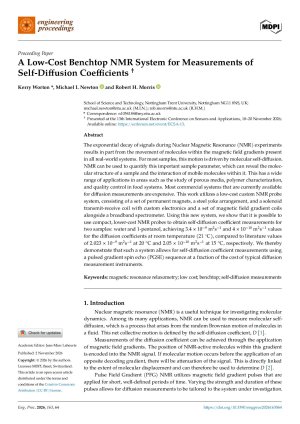
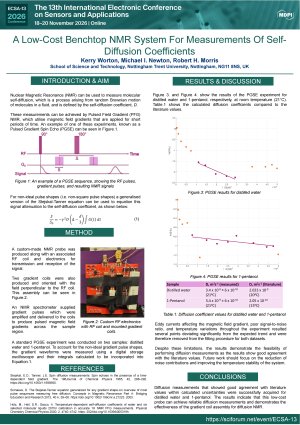
The decay of signal during nuclear magnetic resonance (NMR) relaxometry experiments results in part from the movements of molecules within a magnetic field gradient, known as molecular self-diffusion. By using NMR to quantify this, it is possible to obtain important information regarding the molecular structure of a sample and the interaction of mobile molecules within it. This has a wide range of applications in areas such as the study of porous media, polymer characterisation, and quality control in food systems through the monitoring of areas such as emulsion quality and oxidation.
Most commercial systems that are currently available for self-diffusion coefficient measurements are however particularly expensive. This work utilises an existing low-cost custom NMR probe system, consisting of a set of magnets, steel yoke arrangement, and a solenoid transmit-receive coil with custom tuning and matching boards, alongside a broadband spectrometer. This was then adapted through the addition of two coils positioned perpendicular to the sample that can be used to manipulate the magnetic field and allow for self-diffusion coefficient measurements using a pulsed gradient spin echo (PGSE) sequence.
Using this new system, we have been able to show that it is possible to use compact, lower costing NMR probes to obtain self-diffusion coefficient measurements for a range of samples.
Keywords
Magnetic Resonance Relaxometry
Diffusion
Low Cost
Benchtop
Manuscript
Sciforum-194543engproc-163-00064.pdf
Poster
LowCostDiffusionPoster.pdf
FusionPhys: a multi-source rPPG method for estimating heart rate from facial videos
Bio-Inspired Immune-System-Centric Maintenance Practice for Mining Machines: A Smart Sensor-Fusion Framework