Event submissions
Published
 10.3390/engproc2026163065 (registering DOI)
This submission belongs to the session S8. Robotics, Sensors, and Industry 4.0 of the event The 13th International Electronic Conference on Sensors and Applications
Published date
16 Nov, 2026
Academic Editor
 Francisco Falcone
Citation
Shiven Sankar, Michael Ayomoh, Bio-Inspired Immune-System-Centric Maintenance Practice for Mining Machines: A Smart Sensor-Fusion Framework, in Proceedings of The 13th International Electronic Conference on Sensors and Applications, 18 November–20 November 2026, MDPI: Basel, Switzerland, doi: 10.3390/engproc2026163065
Share
Email
Facebook
Twitter
LinkedIn
Bio-Inspired Immune-System-Centric Maintenance Practice for Mining Machines: A Smart Sensor-Fusion Framework

Shiven Sankar 1
Michael Ayomoh 1
1. Department of Industrial and Systems Engineering, Faculty of Engineering, Built Environment and Information Technology, University of Pretoria, Pretoria 0028, South Africa
Abstract
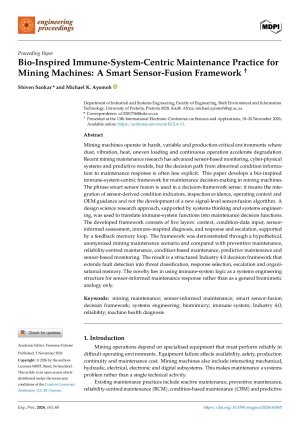
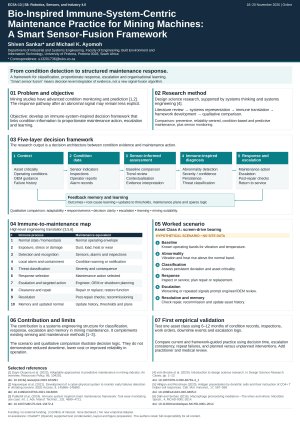
Introduction: Mining machines operate in harsh and changing working environments. Dust, vibration, load variation, heat and continuous production pressure can speed up wear and increase the risk of unplanned downtime. Current maintenance approaches, such as reliability-centred maintenance, condition-based maintenance and predictive maintenance, support machine health monitoring. However, they often focus on detecting deterioration and do not always provide a clear response logic when sensor information is incomplete, fragmented or difficult to interpret. This study develops a bio-inspired immune-system-centric maintenance framework for repairable mining machines, with attention to critical drive, hydraulic, electrical and structural subsystems.
Methods: A systems engineering approach was used to translate biological immune-system behaviour into mining maintenance decision logic. Public mining maintenance literature, selected OEM maintenance logic diagrams, biomimicry reference models and systems thinking principles were used to build the framework. The framework consists of five linked components: a machine condition and benchmark layer, a sensor-fusion input layer, an immune-inspired diagnosis layer, a maintenance response and escalation layer, and a feedback memory layer. Typical sensor inputs include vibration, temperature, pressure, operating load, operating hours and fluid-condition indicators.
Results: The main result is a structured maintenance logic framework that converts machine condition signals into practical maintenance responses. The framework was compared with preventive maintenance, reliability-centred maintenance, condition-based maintenance and predictive maintenance using responsiveness, adaptability, data requirements, feasibility and suitability for mining conditions. The proposed framework adds four decision capabilities: deviation detection against a benchmark, immune-style threat classification, severity-based escalation and memory-based adaptation.
Conclusions: The novelty of the work is the translation of immune-system response behaviour into a systems engineering structure for sensor-based mining maintenance decisions. The contribution is a practical Industry 4.0 framework that links sensor fusion to adaptive maintenance planning in mining environments where operational data may be limited or fragmented.
Keywords
Mining maintenance
sensor fusion
systems engineering
biomimicry
immune system
Industry 4.0
machine health diagnosis
Manuscript
Sciforum-196865engproc-163-00065.pdf
Poster
ECSA13_Sankar_Immune_Maintenance_Poster_A0_v1.pdf
A Low-Cost Benchtop NMR System For Measurements Of Self-Diffusion Coefficients
Assessing Quantization Integrity Across Public Biosignal Representations: A Comparative Study of sEMG and Auditory-Evoked Recordings