Event submissions
Published
 10.3390/engproc2026163067 (registering DOI)
This submission belongs to the session S6. Electronic Sensors, Devices, and Systems of the event The 13th International Electronic Conference on Sensors and Applications
Published date
16 Nov, 2026
Academic Editor
 Jean-Marc Laheurte
Citation
VIJAYARAJA Loganathan, Dhanasekar Ravikumar, Rupa Kesavan, VIDHYA D, Uma Mageshwari K, IoT-Based Solar-Aided Electric Bicycle with Women’s Safety for Urban Commute, in Proceedings of The 13th International Electronic Conference on Sensors and Applications, 18 November–20 November 2026, MDPI: Basel, Switzerland, doi: 10.3390/engproc2026163067
Share
Email
Facebook
Twitter
LinkedIn
IoT-Based Solar-Aided Electric Bicycle with Women’s Safety for Urban Commute

VIJAYARAJA Loganathan 1

Dhanasekar Ravikumar 1

Rupa Kesavan 2

VIDHYA D 3
Uma Mageshwari K 3
1. Department of Electrical and Electronics Engineering, Sri Sairam Engineering College, Chennai, India
2. Department of Computer Science and Engineering, Sri Venkateswara College of Engineering, Sriperumbudur 602117, Tamil Nadu, India
3. Department of Electrical and Electronics Engineering, Sri Sairam Institute of Technology, Chennai 600044, Tamil Nadu, India
Abstract
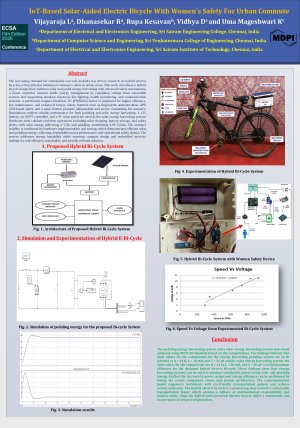
The increasing demand for sustainable and safe mobility has driven research on hybrid electric bicycles, with particular attention to women’s safety in urban areas. This work introduces a hybrid bicycle design that combines solar and pedal energy harvesting with advanced safety mechanisms. A boost converter ensures stable energy management by regulating voltage from renewable sources and supporting auxiliary functions like lighting, health monitoring, and communication systems. A permanent magnet brushless DC (PMBLDC) motor is employed for higher efficiency, low maintenance, and enhanced torque. Safety features such as fingerprint authentication, GPS, GSM-based alerts, and a panic button promote independent and secure commuting for women's. Simulations confirm reliable performance for both pedalling and solar energy harvesting. A 12V battery, an MPPT controller, and a 9V solar panel are used in the solar energy harvesting system. Hardware tests validate real-time operations including solar charging, battery storage, and safety alerts, with solar energy delivering 6 V/hr and pedalling contributing 0.09 V/min. The system's viability is confirmed by hardware implementation and testing, which demonstrates efficient solar and pedalling energy collecting, dependable motor performance, and operational safety alarms. The system addresses energy instability while ensuring compact design and embedded security, making it a cost-effective, sustainable, and socially relevant solution.
Keywords
Green House Gas
Hybrid Electric Bicycle
Intelligent Power Management
Solar Power
Women Protection
Manuscript
Sciforum-192569engproc-163-00067.pdf
Poster
Sciforum-192569-Poster.pdf
Sciforum-192569-Video.mp4
Assessing Quantization Integrity Across Public Biosignal Representations: A Comparative Study of sEMG and Auditory-Evoked Recordings
Mass transfer limitations in the detection of proteins that undergo conformational changes in adsorption-based microfluidic biosensors