Event submissions
Published
 10.3390/engproc2026163071 (registering DOI)
This submission belongs to the session S7. Wearable Sensors and Healthcare Applications of the event The 13th International Electronic Conference on Sensors and Applications
Published date
16 Nov, 2026
Academic Editor
 Jean-Marc Laheurte
Citation
Timothy Malche, Automatic Drinking Event Recognition and Fluid Intake Estimation in Sport Using an Embedded Wearable Sensor, in Proceedings of The 13th International Electronic Conference on Sensors and Applications, 18 November–20 November 2026, MDPI: Basel, Switzerland, doi: 10.3390/engproc2026163071
Share
Email
Facebook
Twitter
LinkedIn
Automatic Drinking Event Recognition and Fluid Intake Estimation in Sport Using an Embedded Wearable Sensor

Timothy Malche 1
1. Department of Computer Applications, Manipal University Jaipur, Jaipur, Rajasthan, India
Abstract
Introduction: Proper hydration is important for athletic performance and recovery, but many athletes do not accurately track how much water or energy fluid they drink during training. At present many system uses bottles with hardware like weight sensors, liquid-level sensors, and flow sensor. This study proposes a wearable sensor that uses an embedded accelerometer sensor and TinyML running on microcontroller to automatically detect drinking activity and estimate fluid intake.
Methods: A three-axis accelerometer and a microcontroller were embedded in a wearable wrist band. Data were collected from different participants performing three activities such as idle, pickup, active drinking with anomaly detection algorithm. When a player is not performing any of the predefined activities which are related to drinking detection, the anomaly detection algorithm classifies it as different activity hence not included in analysis. Features were extracted from the accelerometer signals and used to train a neural network. Detected drinking events and timestamps are transmitted through Bluetooth Low Energy. Fluid intake was estimated from the duration and frequency of drinking events.
Results: The TinyML model achieved 93.2% classification accuracy across the three states with an inference latency of <5 ms. The system operated continuously while remaining within the available power budget. The system successfully recorded drinking events and generated session-level hydration logs for all participants.
Conclusions: The results of the proposed system shows that TinyML model can accurately recognize drinking activities and support automatic hydration monitoring. The system offers session level drinking logs and fluid intake estimates that can assist athletes to stay optimally hydrated . Future work will include adding data from additional participants, personalized hydration recommendations, and real-time alerts when fluid intake is less than the recommended levels.
Keywords
TinyML
Wearable Sensor
Good Health and Well-Being
Health Monitoring
Sports AI
Manuscript
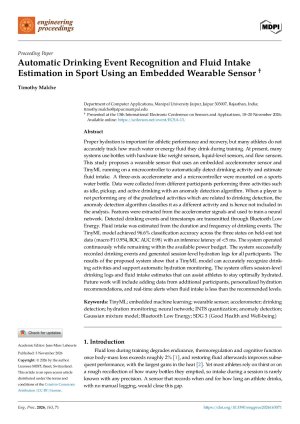
Sciforum-192190engproc-163-00071.pdf
Poster
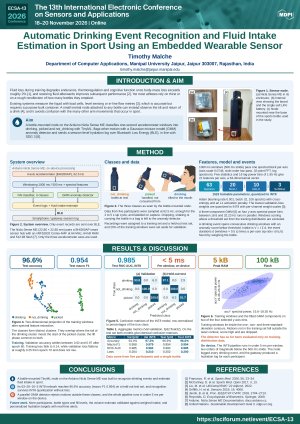
ECSA-13_poster_drinking_hydration.pdf
IoT-Enabled Vision-Based Assistance System for Paralyzed Individuals with Real-Time Remote Alerts
Embedded Acoustic Sensing for Infant Cry Classification and Intelligent Comfort Response