Event submissions
Published
 10.3390/engproc2026163074 (registering DOI)
This submission belongs to the session S4. Sensors and Artificial Intelligence of the event The 13th International Electronic Conference on Sensors and Applications
Published date
16 Nov, 2026
Academic Editor
 Francisco Falcone
Citation
Nikita Nikitov, Ivan Georgiev, Slavi Georgiev, Residual-Allocation Control in Color Correction Matrix Calibration via Weighted Constrained Models, in Proceedings of The 13th International Electronic Conference on Sensors and Applications, 18 November–20 November 2026, MDPI: Basel, Switzerland, doi: 10.3390/engproc2026163074
Share
Email
Facebook
Twitter
LinkedIn
Residual-Allocation Control in Color Correction Matrix Calibration via Weighted Constrained Models

Nikita Nikitov 1
Ivan Georgiev 1,2

Slavi Georgiev 1,2
1. Department of Applied Mathematics and Statistics, University of Ruse “Angel Kanchev”, 8 Studentska Street, 7004 Ruse, Bulgaria
2. Institute of Mathematics and Informatics, Bulgarian Academy of Sciences, 8 Acad. Georgi Bonchev Street, 1113 Sofia, Bulgaria
Abstract
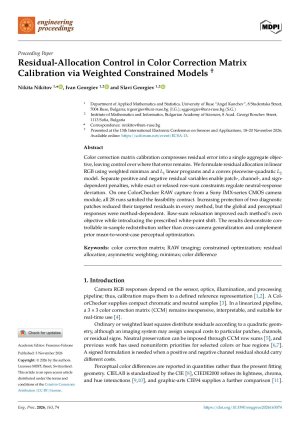
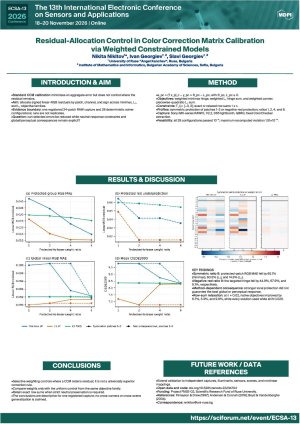
Digital imaging sensors exhibit device-dependent spectral responses caused by differences in sensor characteristics, optical systems, and acquisition conditions. Color Correction Matrices (CCMs) are widely used to transform camera-dependent RGB responses toward standardized color representations; however, conventional least-squares and unconstrained nonlinear optimization approaches provide limited control over the distribution of residual color errors across calibration targets. This work presents a comparative optimization framework for CCM estimation focused on perceptual accuracy in digital imaging sensor calibration. The framework evaluates established approaches, including mean ΔE2000 minimization, white-point constrained optimization, weighted ΔE2000 optimization, and minimax error reduction, together with three proposed constrained optimization formulations: a minimax model solved through Linear Programming, an L1 model minimizing weighted absolute deviations, and an L2 formulation based on Quadratic Programming with analytical gradients. The constrained models introduce positive and negative residual variables, patch- and channel-dependent weighting coefficients, and row-sum relaxation parameters. This formulation enables controlled redistribution of correction errors among individual color regions and RGB channels, providing additional flexibility compared with global error minimization strategies. The proposed framework is evaluated using Macbeth ColorChecker reference data and RAW camera captures. The optimization methods are compared using perceptual and numerical quality metrics, including mean and maximum ΔE2000, ΔC, ΔE94, and chroma preservation indicators. The results provide a basis for analyzing optimization strategies for imaging sensor color calibration and support further development of adaptive correction approaches for improved perceptual consistency across different acquisition conditions.
Keywords
color correction matrix
camera sensor calibration
CIEDE2000
constrained optimization
nonlinear programming
perceptual color difference
Manuscript
Sciforum-196308engproc-163-00074.pdf
Poster
ECSA13_poster_final.pdf
Low-Cost IoT-Based Formaldehyde Monitoring for Preventive Conservation in Museum Display Cases
Development of a Didactic Plant with Material Classification Using an Intelligent Sensor