Event submissions
EventsMOL2NET'16, Conference on Molecular, Biomed., Comput. & Network Science and Engineering, 2nd ed.
Published

This submission belongs to the session 06. MODECO-01: Workshop on Molecular Diversity & Ecosystems, Puyo, Ecuador-Porto, Portugal, 2016 of the event MOL2NET'16, Conference on Molecular, Biomed., Comput. & Network Science and Engineering, 2nd ed.
Published date
15 Nov, 2016
Citation
Carlos E Vazquez, Dora P Maul, Luis A Cendan, Contrasting Effects of Aqueous Vermicompost Extract Mixtures on Growth of Brassica oleracea var. sabellica, in Proceedings of MOL2NET'16, Conference on Molecular, Biomed., Comput. & Network Science and Engineering, 2nd ed., 15 October–20 October 2022, MDPI: Basel, Switzerland, doi: 10.3390/mol2net-02-07006
Share
Email
Facebook
Twitter
LinkedIn
Contrasting Effects of Aqueous Vermicompost Extract Mixtures on Growth of Brassica oleracea var. sabellica
'%3e%3cpath%20d='M12.6647%2010.9104C12.4176%2010.325%2012.0589%209.7933%2011.6088%209.34485C11.16%208.89511%2010.6283%208.53653%2010.0432%208.28891C10.038%208.28629%2010.0327%208.28498%2010.0275%208.28236C10.8437%207.69282%2011.3743%206.73252%2011.3743%205.64907C11.3743%203.85423%209.92005%202.40002%208.12522%202.40002C6.33038%202.40002%204.87618%203.85423%204.87618%205.64907C4.87618%206.73252%205.40677%207.69282%206.22296%208.28367C6.21772%208.28629%206.21248%208.2876%206.20724%208.29022C5.62031%208.53783%205.09365%208.89287%204.64167%209.34616C4.19192%209.79496%203.83334%2010.3266%203.58573%2010.9117C3.34247%2011.4846%203.21128%2012.0987%203.19925%2012.721C3.1989%2012.735%203.20135%2012.7489%203.20646%2012.7619C3.21157%2012.7749%203.21924%2012.7868%203.22901%2012.7968C3.23877%2012.8068%203.25045%2012.8148%203.26334%2012.8202C3.27623%2012.8256%203.29007%2012.8284%203.30406%2012.8284H4.09012C4.14776%2012.8284%204.19362%2012.7825%204.19493%2012.7262C4.22113%2011.7148%204.62726%2010.7676%205.34519%2010.0497C6.08802%209.30686%207.07452%208.89811%208.12522%208.89811C9.17592%208.89811%2010.1624%209.30686%2010.9052%2010.0497C11.6232%2010.7676%2012.0293%2011.7148%2012.0555%2012.7262C12.0568%2012.7839%2012.1027%2012.8284%2012.1603%2012.8284H12.9464C12.9604%2012.8284%2012.9742%2012.8256%2012.9871%2012.8202C13%2012.8148%2013.0117%2012.8068%2013.0214%2012.7968C13.0312%2012.7868%2013.0389%2012.7749%2013.044%2012.7619C13.0491%2012.7489%2013.0515%2012.735%2013.0512%2012.721C13.0381%2012.0947%2012.9084%2011.4856%2012.6647%2010.9104ZM8.12522%207.90243C7.52388%207.90243%206.95792%207.66793%206.53214%207.24215C6.10636%206.81636%205.87185%206.2504%205.87185%205.64907C5.87185%205.04773%206.10636%204.48177%206.53214%204.05599C6.95792%203.63021%207.52388%203.3957%208.12522%203.3957C8.72655%203.3957%209.29252%203.63021%209.7183%204.05599C10.1441%204.48177%2010.3786%205.04773%2010.3786%205.64907C10.3786%206.2504%2010.1441%206.81636%209.7183%207.24215C9.29252%207.66793%208.72655%207.90243%208.12522%207.90243Z'%20fill='%235D1EE1'/%3e%3c/g%3e%3c/svg%3e)
Carlos E Vazquez 1
Dora P Maul 1
Luis A Cendan 1
1. School of Science, Technology and Engineering Management, St. Thomas University, Miami Gardens, FL 33054, USA
Abstract
Contrasting Effects of Aqueous Vermicompost Extract Mixtures on Growth of Brassica oleracea var. sabellica
Luis Alfredo Cendan, Carlos Vazquez and Dora Pilar Maul.
School of Science, Technology, and Engineering Management, St. Thomas University, Miami Gardens, FL 33054
Organic fertilizers not only maintain soil fertility but enhance the biological activity of the soil, which improve the efficiency of nutrient use by the plants. Vermicompost, a nutrient-rich organic fertilizer made by composting earthworms can be used in the preparation of aqueous extracts known to increase crop yield and plant health. Vermicompost was produced through cultivation of Red Wriggler worms (Eisenia fetida), a common composting species and used in the preparation of aqueous fertilizing mixtures. Kale (Brassica oleracea var. sabellica), a leafy vegetable known for its high nutritional properties, was grown in the STU organic garden in the spring of 2016. Plants were fertilized with one of three vermicompost-based solutions containing different combinations of organic additives, such as fish emulsion, corn syrup and/or a seaweed blend. Mixtures were prepared weekly and applied, in 4 gal. doses to the plants in each study group twice a week over the course of 10 weeks. Upon harvest, the height, wet weight, and dry weight of the plants were measured. ANOVA and Tukey test analysis showed a significant positive effect on all vermicompost-treated plants compared to the control. Kale plants receiving the mixture T1 (a combination of vermicompost and fish emulsion) resulted in significantly greater height, wet weight, and dry weight in comparison to the other treatments.
Keywords
Poster
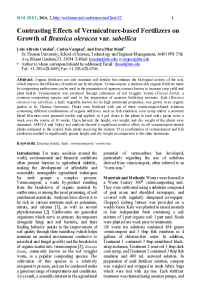
Mol2Net kale 11-14-16.pdf
The effect of Hedgehog signaling on in vivo neuronal morphogenesis.
Identification of high affinity small molecules targeting ESR1 inhibitors for the treatment of Breast Cancer