Event submissions
Published
 10.3390/engproc2026163078 (registering DOI)
This submission belongs to the session S4. Sensors and Artificial Intelligence of the event The 13th International Electronic Conference on Sensors and Applications
Published date
16 Nov, 2026
Academic Editor
 Francisco Falcone
Citation
Ramazan Ertuğrul Aydoğan, Fatima Sapundzhi, Design and simulation evaluation of an embedded multi-sensor ADAS architecture with AI-assisted collision warning, in Proceedings of The 13th International Electronic Conference on Sensors and Applications, 18 November–20 November 2026, MDPI: Basel, Switzerland, doi: 10.3390/engproc2026163078
Share
Email
Facebook
Twitter
LinkedIn
Design and simulation evaluation of an embedded multi-sensor ADAS architecture with AI-assisted collision warning

Ramazan Ertuğrul Aydoğan 1,2

Fatima Sapundzhi 1
1. Department of Communication and Computer Engineering, Faculty of Engineering, South-West University “Neofit Rilski”, 66 Ivan Mihaylov Str., 2700 Blagoevgrad, Bulgaria
2. Department of Electrical and Electronics Engineering, Faculty of Engineering, Gaziantep University, 27310 Gaziantep, Türkiye
Abstract
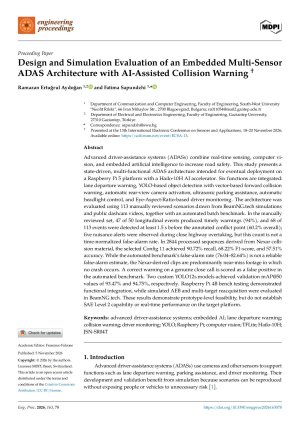
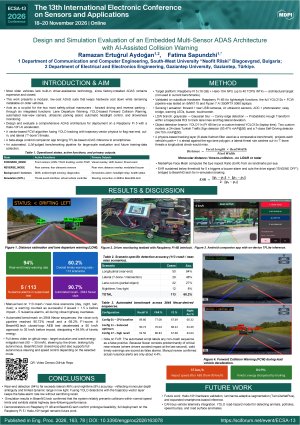
Advanced Driver Assistance Systems (ADAS) nowadays use real-time sensors, computer vision, and embedded artificial intelligence to increase road safety. Development of affordable, multi-functional ADAS solutions for low-cost embedded platforms remains challenging due to limited computing resources and the need to process sensor data simultaneously. The purpose of this study is to present a comprehensive ADAS architecture designed for deployment on a Raspberry Pi 5 platform using the Hailo-10H AI accelerator. The proposed system integrates six safety and convenience functions: Lane Departure Warning, YOLO-based object detection, automated rearview camera activation, ultrasonic parking assistance, intelligent headlight control, and driver drowsiness monitoring based on facial landmarks and Eye Aspect Ratio estimation.
Resource allocation depends on the operational state of the vehicle, according to a multi-threaded, state-based software model. The algorithm combines object tracking with motion vector analysis to detect rear-end collisions, intersections, and side impacts. The system was evaluated using 113 simulated crash and near-miss scenarios. The proposed approach achieved a 90% detection rate for longitudinal rear events and a 60.1% overall detection rate across all scenarios tested. Simulation loop testing with BeamNG.tech further demonstrates Level 2 active intervention capabilities, including automatic emergency braking.
An Android ADAS application was created in Kotlin, targeting smartphones using TFLite inference. An automated data collection pipeline for AI training with human-in-the-loop reward scoring was created to aid future model improvement.
The obtained results demonstrate that low-cost embedded platforms can support integrated multi-sensor ADAS functions when combined with optimized state-based processing and perception, aided by artificial intelligence. Future work will focus on hardware implementation, improved training data collection, and optimization of smartphone-based inference.
Keywords
Advanced Driver-Assistance Systems (ADAS)
Lane Departure Warning
Forward Collision Warning
Eye Aspect Ratio
YOLO
Computer Vision
TFLite
Android
Sensor Fusion
Real-Time Systems
Raspberry Pi
Hailo-10H
JSN-SR04T.
Manuscript
Sciforum-195321engproc-163-00078.pdf
Poster
ECSA-13_Poster_Ramazan.pdf
ECSA-13_Poster_Video_Ramazan.mp4
A Fault-Tolerant Edge Computing Architecture for Low-Latency Actuation in Agricultural IoT
FLAP‑SIX: A Fixed‑Flapper, Six‑Compartment Smart Bin with a Lightweight AI Model