Event submissions
Published
 10.3390/engproc2026163081 (registering DOI)
This submission belongs to the session S3. Sensor Networks, IoT, Smart Cities and Health Monitoring of the event The 13th International Electronic Conference on Sensors and Applications
Published date
16 Nov, 2026
Academic Editor
 Francisco Falcone
Citation
Selvaprakash Ramalingam, Om Prakash Patidar, Vijay N, Harisha R, Sinto Antoo, Vinay H T, Krishnamoorthi S, Ajay Kushwa, G J Abhishek, Kartik Neog, IoT-Enabled Smart Monitoring in Vanya Sericulture: A Four-Tier Sensor Framework for Muga and Eri Rearing Systems, in Proceedings of The 13th International Electronic Conference on Sensors and Applications, 18 November–20 November 2026, MDPI: Basel, Switzerland, doi: 10.3390/engproc2026163081
Share
Email
Facebook
Twitter
LinkedIn
IoT-Enabled Smart Monitoring in Vanya Sericulture: A Four-Tier Sensor Framework for Muga and Eri Rearing Systems

Selvaprakash Ramalingam 1
Om Prakash Patidar 1
Vijay N 1
Harisha R 1
Sinto Antoo 1
Vinay H T 1
Krishnamoorthi S 1
Ajay Kushwa 1
G J Abhishek 1
Kartik Neog 1
1. CSB-Central Muga Eri Research and Training Institute, Lahdoigarh, Jorhat, Assam, India
Abstract
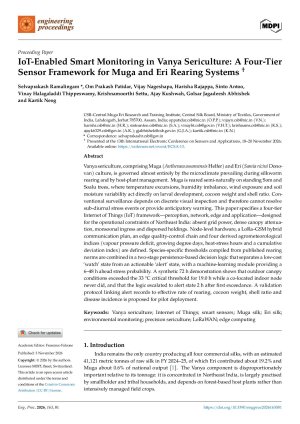
Vanya sericulture, particularly Muga (Antheraea assamensis) and Eri (Samia ricini) cultivation, is closely governed by prevailing environmental conditions during silkworm rearing and host plant management. Temperature fluctuations, humidity imbalances, wind exposure, and soil moisture variability can directly impair larval development, reduce cocoon weight, and lower overall silk yield. Conventional monitoring, dependent almost entirely on visual field inspection, leaves limited scope for anticipating environmental stress or detecting early disease signs under dynamic agro-climatic conditions.
Sensor-based IoT systems address this gap through continuous recording of critical rearing and field parameters. Sensors measuring temperature, relative humidity, soil moisture, and ambient gases are embedded within rearing houses and plantations, connected to microcontroller platforms such as Arduino, ESP32, or Raspberry Pi. Data transmission via Wi-Fi, GSM, or LoRa networks allows readings to reach cloud storage or mobile interfaces, enabling remote access across dispersed field locations in Northeast India.
Sustained deviations in rearing conditions frequently precede disease outbreaks, including pébrine, flacherie, and uzi fly infestation, where early sensor-based alerts can narrow the window between stress onset and corrective action. Emerging integration of machine learning with live sensor data is further enabling predictive analytics, forecasting adverse conditions before visible field symptoms develop. This holds particular relevance for Muga, where semi-natural outdoor rearing environments make manual surveillance especially inconsistent.
Wider adoption of such systems can reduce labor dependency, improve cocoon quality consistency, and advance precision-based silk farming across India's Vanya sector.
Keywords
Vanya Sericulture
IoT
Smart Sensors
Muga Silk
Eri Silk
Environmental Monitoring
Precision Sericulture
Manuscript
Sciforum-188523engproc-163-00081-v2.pdf
Poster
Vanya_IoT_Conference_Deck_v2.pdf
Precision Agriculture Through Machine Learning and IoT: A Novel Framework for Efficient Irrigation Management
An Automated Gait Classification using Inertial Sensor Data and Temporal Deep Learning Architectures