Event submissions
Published
 10.3390/engproc2026163082 (registering DOI)
This submission belongs to the session S4. Sensors and Artificial Intelligence of the event The 13th International Electronic Conference on Sensors and Applications
Published date
16 Nov, 2026
Academic Editor
 Stefano Mariani
Citation
Caran Varshana T, Ramana B, Jashila Nair Mogan, Vijayalakshmi S, Sumendra Yogarayan, Paramasivam Alagumariappan, An Automated Gait Classification using Inertial Sensor Data and Temporal Deep Learning Architectures, in Proceedings of The 13th International Electronic Conference on Sensors and Applications, 18 November–20 November 2026, MDPI: Basel, Switzerland, doi: 10.3390/engproc2026163082
Share
Email
Facebook
Twitter
LinkedIn
An Automated Gait Classification using Inertial Sensor Data and Temporal Deep Learning Architectures

Caran Varshana T 1

Ramana B 1
Jashila Nair Mogan 2
Vijayalakshmi S 3
Sumendra Yogarayan 2
Paramasivam Alagumariappan 1
1. Department of Biomedical Engineering, Vel Tech Rangarajan Dr. Sagunthala R&D Institute of Science and Technology, Chennai 600062, India
2. Faculty of Information Science and Technology, Multimedia University, 75450 Ayer Keroh Lama, Melaka, Malaysia.
3. Department of Electronics and Communication Engineering, Vel Tech Rangarajan Dr. Sagunthala R&D Institute of Science and Technology, Chennai 600062, India
Abstract
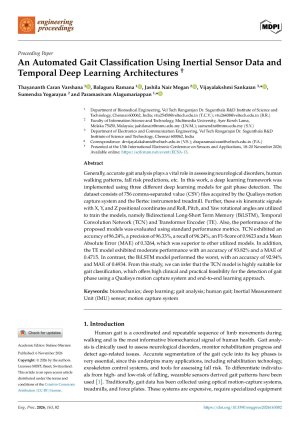
Generally, accurate GAIT analysis plays a vital role to assess neurological disorders, human walking patterns, fall risk predictions etc. In this work, an end-to-end supervised learning framework is proposed using three different deep learning models for GAIT phase detection. The dataset comprises of 756 comma seperated value (CSV) files acquired using a Qualisys motion capture system and Bertec instrumented treadmill. Further, these six kinematic signals with X, Y, Z positional coordinates and Roll, Pitch, Yaw rotational angles are utilized to train three different deep learning models namely Bidirectional Long-Short Term Memory (BiLSTM), Temporal Convolution Network (TCN) and Transformer Encoder (TE). Also, the performance of proposed deep learning models is evaluated using standard metrics which includes accuracy, precision, recall, F1-Score and Mean Absolute Error (MAE). From the results, it is demonstrated that the TCN exhibits an accuracy of 96.24%, precision of 96.33%, recall of 97%, F1-Score of 0.9623 and Mean Absolute Error (MAE) of 0.3264 which is superior than other utilized models. In addition, the Bi-LSTM model exhibited moderate performance with an accuracy of 89.37% and MAE of 0.9079. In contrast, the TE model performed poor by attaining an accuracy of 66.41% and MAE of 2.3686. The findings indicate that the TCN model is highly suitable for GAIT classification which offers high clinical and practical feasibility for the detection of GAIT phase using a Qualisys motion capture system and end-to-end learning approach.
Keywords
Biomechanics
Deep Learning
GAIT analysis
Human GAIT
Inertial Measurement Unit (IMU) sensor
Motion Capture System
Manuscript
sciforum-195672engproc-163-00082.pdf
IoT-Enabled Smart Monitoring in Vanya Sericulture: A Four-Tier Sensor Framework for Muga and Eri Rearing Systems
An Adaptive Imbalance-Aware Hybrid SVM Framework for Classification of Imbalanced Datasets