Event submissions
Published
 10.3390/engproc2026163085 (registering DOI)
This submission belongs to the session S6. Electronic Sensors, Devices, and Systems of the event The 13th International Electronic Conference on Sensors and Applications
Published date
16 Nov, 2026
Academic Editor
 Jean-Marc Laheurte
Citation
Paula Alejandra Ortiz-Santana, Juan Morales-Duran, Erick Reyes-Vera, Low-Cost Thermal Imaging Feedback for Safe Closed-Loop RF Hyperthermia Regulation, in Proceedings of The 13th International Electronic Conference on Sensors and Applications, 18 November–20 November 2026, MDPI: Basel, Switzerland, doi: 10.3390/engproc2026163085
Share
Email
Facebook
Twitter
LinkedIn
Low-Cost Thermal Imaging Feedback for Safe Closed-Loop RF Hyperthermia Regulation

Paula Alejandra Ortiz-Santana 1,2
Juan Morales-Duran 1

Erick Reyes-Vera 3
1. Department of Systems, Engineering Faculty, Institución Universitaria ITM, Medellín 050034, Colombia
2. Department of Mechatronics Engineering, Applied Sciences and Engineering Faculty, Universidad EAFIT, Medellín 050003, Colombia
3. Department of Electronic and Telecommunications, Engineering Faculty, Institución Universitaria ITM, Medellín 050034, Colombia
Abstract
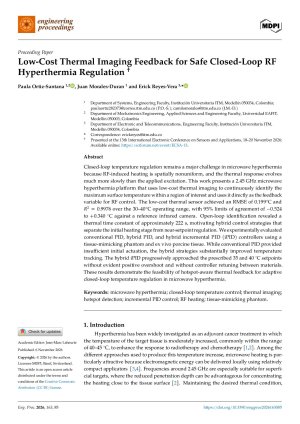
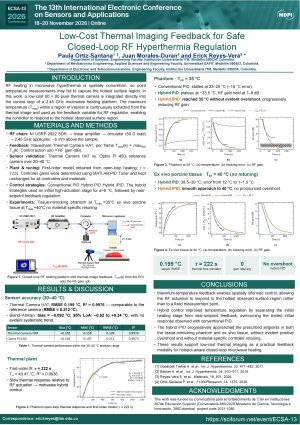
Introduction: Melanoma is a type of cancer for which radiofrequency hyperthermia has been investigated as a treatment modality, which uses electromagnetic waves to induce heat in tissues. Yet this technique will require a constant-temperature detection system to prevent burns in the affected area during treatment. The low-cost thermal camera was validated as an independent feedback sensor suitable for safe and effective closed-loop RF thermal regulation in this investigation.
Methods: The platform includes an NI USRP-2922 software-defined radio, an RF amplifier, an antenna, and a thermal camera HAT for real-time temperature feedback, with FLIR and Optris cameras used as external references. After establishing a first-order thermal plant model, we compared three control strategies. These were conventional PID, hybrid absolute PID, and hybrid incremental PID. The hybrid controllers applied constant RF power when the temperature error exceeded 8 °C and switched to PID or iPID regulation near the target temperature. To evaluate the controller’s performance under different conditions, two samples with different characteristics were used, a mannequin at 35 °C and ex vivo pork at 40 °C.
Results: The conventional PID controller did not reach the target temperature, remaining over 10 °C below the setpoint and showing actuator chattering. The hybrid absolute PID managed to reach the regulation region but had a steady-state offset of about 2% and fluctuations in the control signal. In contrast, the hybrid iPID achieved stable regulation with both materials, maintaining steady-state errors of below 0.3% for the phantom and 0.2% for pork meat. It reached the regulation region in roughly 1300 seconds while keeping control action smooth.
Conclusions: With the appropriate control strategy, low-cost thermal camera can constitute the primary feedback sensor for closed-loop RF hyperthermia. The hybrid iPID controller performed best of all controllers, providing minimal steady-state error and fluctuation in the actuator for stability.
Keywords
RF hyperthermia
thermal camera feedback
hybrid incremental PID
software-defined radio
temperature control
tissue-mimicking phantom
Manuscript
sciforum-192548engproc-163-00085.pdf
Poster
Low-Cost Thermal Imaging Feedback for Safe Closed-Loop RF Hyperthermia Regulation.pdf
Smart Irrigation Demand Forecasting for Potato Cultivation Using IoT and Machine Learning
Autonomous Sensor-Based Rainwater Irrigation System for Isolated Agricultural Areas