Event submissions
Published
 10.3390/engproc2026163086 (registering DOI)
This submission belongs to the session S5. Smart Agriculture Sensors of the event The 13th International Electronic Conference on Sensors and Applications
Published date
16 Nov, 2026
Academic Editor
 Stefano Mariani
Citation
Peter Tsonkov, Fatima Sapundzhi, Slavi Georgiev, Autonomous Sensor-Based Rainwater Irrigation System for Isolated Agricultural Areas, in Proceedings of The 13th International Electronic Conference on Sensors and Applications, 18 November–20 November 2026, MDPI: Basel, Switzerland, doi: 10.3390/engproc2026163086
Share
Email
Facebook
Twitter
LinkedIn
Autonomous Sensor-Based Rainwater Irrigation System for Isolated Agricultural Areas

Peter Tsonkov 1

Fatima Sapundzhi 1

Slavi Georgiev 2,3
1. Department of Communication and Computer Engineering, Faculty of Engineering, South-West University “Neofit Rilski”, 66 Ivan Myhailov Str., 2700 Blagoevgrad, Bulgaria
2. Department of Applied Mathematics and Statistics, Faculty of Natural Sciences and Education, University of Ruse, 8 Studentska Str., 7004 Ruse, Bulgaria
3. Institute of Mathematics and Informatics, Bulgarian Academy of Sciences, 1113 Sofia, Bulgaria
Abstract
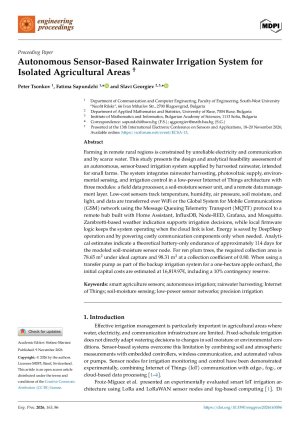
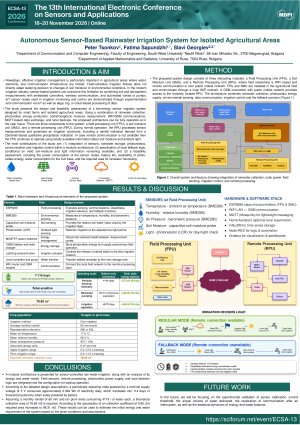
Farming in remote, rural regions faces big challange: there is often no steady electricity, no reliable communication, and water is scarce. This study designs and tests an autonomous irrigation system that uses sensors and runs on rainwater - built with small farms in mind, especially where both water and energy matter most. The system pulls together rainwater harvesting, solar panels, scattered environmental sensors, and smart irrigation controls. All of it runs on a low-power Internet of Things setup.
The system consists of three interacting modules: the field data processor, a sensor unit that checks soil moisture, and a remote data management layer. Low-cost sensors track temperature, humidity, air pressure, soil moisture, and light. Data zips over WiFi or GSM with MQTT to a remote hub built with Home Assistant, InfluxDB, Node-RED, Grafana, and Mosquitto. The system uses weather predictions from the Zambretti algorithm for smarter irrigation decisions, and when the link to the cloud goes down, firmware logic lets the system keep running with some autonomy. To save energy, it uses DeepSleep mode and only powers up costly communication parts when needed.
Early energy tests look promising. On just batteries, the soil moisture sensor can last around 114 days. With solar charging, there is enough energy to keep things running daily. Water-demand checks for fruit trees show rainwater is enough for drip irrigation here, as long as 78.65 m² of collecting area is available.
Altogether, this setup paves the way for smart irrigation in isolated areas, tying together monitoring, water capture, low-energy networking, and backup controls. Next steps include adding LoRaWAN, introducing AI-powered predictions, and running longer field tests.
Keywords
smart agriculture sensors
autonomous irrigation
rainwater harvesting
Internet of Things
soil moisture sensing
low-power sensor networks
precision irrigation
Manuscript
sciforum-196327engproc-163-00086.pdf
Poster
Poster ECSA PT.pdf
Low-Cost Thermal Imaging Feedback for Safe Closed-Loop RF Hyperthermia Regulation
Privacy-Preserving Intelligent Framework for Soil-Fertility Prediction in Precision Agriculture