Event submissions
Published
 10.3390/engproc2026163087 (registering DOI)
This submission belongs to the session S5. Smart Agriculture Sensors of the event The 13th International Electronic Conference on Sensors and Applications
Published date
16 Nov, 2026
Academic Editor
 Stefano Mariani
Citation
Dasaradha Arangi, Neelamadhab Padhy, Privacy-Preserving Intelligent Framework for Soil-Fertility Prediction in Precision Agriculture, in Proceedings of The 13th International Electronic Conference on Sensors and Applications, 18 November–20 November 2026, MDPI: Basel, Switzerland, doi: 10.3390/engproc2026163087
Share
Email
Facebook
Twitter
LinkedIn
Privacy-Preserving Intelligent Framework for Soil-Fertility Prediction in Precision Agriculture

Dasaradha Arangi 1
Neelamadhab Padhy 1
1. Department of Computer Science and Engineering (AIML), GIET University, Gunupur 765022, Odisha, India
Abstract
Context:Using sophisticated data-driven technologies, precision agriculture has emerged as a crucial strategy for enhancing agricultural production, sustainability, and resource management. In centralized learning approaches, farmers need to share their farm data with the central server . It raises issues of data ownership, security, and privacy in distributed agricultural settings.
Objective: In this paper, our primary objective is to develop a privacy-preserving intelligent framework for soil fertility prediction in precision agriculture. This study's goal is to compare the predictive performance of several intelligent models and to assess Federated Learning's ability to enable safe, decentralized, and collaborative agricultural analytics.
Materials and Methods: This study utilized 10 ML models and 5 DL models and evaluated them using performance metrics such as accuracy, precision, recall, F1-score, and Cohen’s Kappa. We also developed a privacy-preserving intelligent framework, adopting a federated learning mechanism with five clients and 20 communication rounds, using FedAvg (federated averaging aggregation). The dataset was divided into different farms to \simulate real-world distributed agriculture systems.
Results: From our experimental observations, the Extra Tree (ET) classifier obtained the highest accuracy of 93.94%, F1-Score of 93.99, and Kappa value of 0.90. Similarly, the Shallow MLP model from DL obtained an accuracy of 93.18% and a Kappa value of 0.8977. It has been reported that the FL framework achieved 84.47% accuracy and a Kappa score of 0.76. Apart from these, our framework preserves farm-level data privacy and removes the need for centralized data sharing. The experimental work demonstrates that distributed learning is a secure and collaborative option for smart agriculture. Several Multi-Layer Perceptron (MLP) architectures were constructed and compared to conduct deep learning analysis. The Shallow MLP model with a 128-64 neuron architecture achieved better performance.
Keywords
Machine Learning
Deep learning
Centralized model
Distributed model
Federated Learnign Precision Agriculture
Manuscript
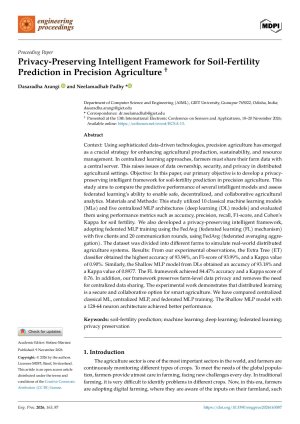
sciforum-191766engproc-163-00087.pdf
Autonomous Sensor-Based Rainwater Irrigation System for Isolated Agricultural Areas
Lightweight TCN-Based Stress Classification on High-Fidelity Physiological Signals from the NEXUS 10 MKII Medical Device