Event submissions
Published
 10.3390/engproc2026163090 (registering DOI)
This submission belongs to the session S5. Smart Agriculture Sensors of the event The 13th International Electronic Conference on Sensors and Applications
Published date
16 Nov, 2026
Academic Editor
 Stefano Mariani
Citation
Seyedeh Sara Hosseini Jangjoo, Jaho Seo, Data-Efficient 3D Plant Phenotyping Using RL-Based Camera Trajectory Planning , in Proceedings of The 13th International Electronic Conference on Sensors and Applications, 18 November–20 November 2026, MDPI: Basel, Switzerland, doi: 10.3390/engproc2026163090
Share
Email
Facebook
Twitter
LinkedIn
Data-Efficient 3D Plant Phenotyping Using RL-Based Camera Trajectory Planning

Seyedeh Sara Hosseini Jangjoo 1
Jaho Seo 1
1. Department of Automotive and Mechanical Engineering, Ontario Tech University, Oshawa, Canada
Abstract
Introduction:
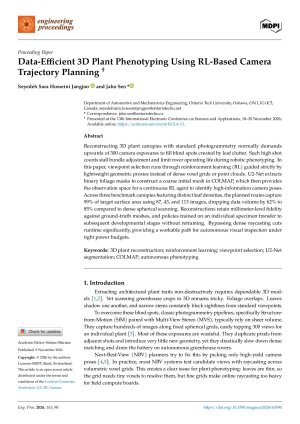
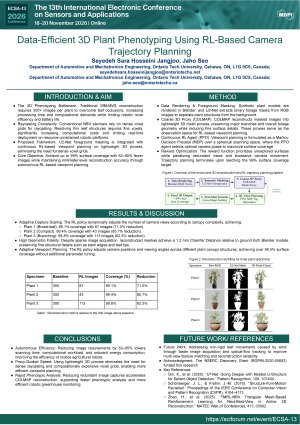
High-fidelity 3D plant reconstruction typically demands extensive datasets, often exceeding 300 images per specimen to ensure structural integrity. Such redundancy spikes computational overhead and data acquisition time, highlighting a critical need for optimized viewpoint selection. To address this problem, this study develops an automated pipeline combining Reinforcement Learning (RL) and U2-Net segmentation to minimize required 2D images while maintaining 99% surface coverage for botanical modeling.
Methods:
Synthetic datasets were first generated using open-source plant models in Blender. A U2-Net architecture performed semantic segmentation to convert 2D RGB images into binary masks, isolating botanical features from the background. These masks were processed through COLMAP to reconstruct simplified 3D proxies, which then served as the training environment for an RL agent. The agent analyzed these simplified geometries to plan optimal camera trajectories, identifying the most informative viewpoints for maximum geometric coverage. Once trained on a specific plant, this policy directly generalizes to similar species across different growth stages without retraining.
Results:
The RL-optimized trajectories significantly cut image counts compared to the 300-image baseline. For three test specimens, the system achieves near-complete reconstruction using just 87 images for Plant 1, 43 for Plant 2, and 113 for Plant 3. Quantitative analysis confirms these reduced datasets yield approximately 99% total surface coverage, eliminating data redundancy without sacrificing quality.
Conclusions:
Integrating U2-Net segmentation with RL-based path planning streamlines the 3D reconstruction process. By reducing image acquisition by up to 85%, this framework provides a scalable solution for high throughput phenotyping and robotic agricultural monitoring where data efficiency is paramount.
Keywords
3D reconstruction in plant phenotyping
Reinforcement Learning
Viewpoint Selection
U2-Net Segmentation
COLMAP
Nerf
Data Efficiency
Manuscript
sciforum-191165engproc-163-00090.pdf
Poster
ECSA_Poster.pdf
ECSA_Video.mp4
Off-Grid Infrastructure for Sustainable Water Management
A Novel Lightweight Deep Learning Model for Classifying Breast Cancer