Event submissions
Published
This submission belongs to the session S1. Chemo- and Biosensors of the event The 13th International Electronic Conference on Sensors and Applications
Published date
16 Nov, 2026
Academic Editor
 Stefano Mariani
Citation
Dimitrios Papakyriakou, Eleni Lamprou, Despina P. Kalogianni, Assessment of honey authenticity using a lateral flow immunoassay for the detection of major royal jelly protein 1., in Proceedings of The 13th International Electronic Conference on Sensors and Applications, 18 November–20 November 2026, MDPI: Basel, Switzerland
Share
Email
Facebook
Twitter
LinkedIn
Assessment of honey authenticity using a lateral flow immunoassay for the detection of major royal jelly protein 1.

Dimitrios Papakyriakou 1
Eleni Lamprou 1

Despina P. Kalogianni 1
1. Group of Analytical Chemistry & Nanotechnology, Department of Chemistry, University of Patras, GR26504, Rio, Patras, Greece
Abstract
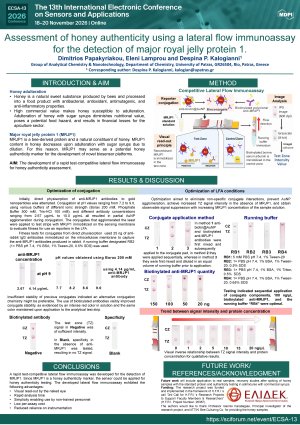
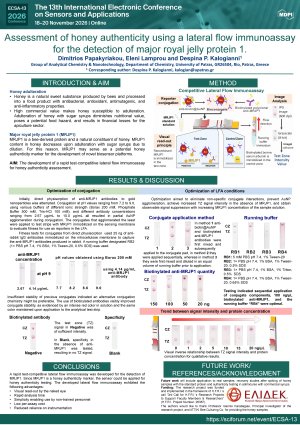
Honey is a natural sweet substance produced by bees of the species Apis mellifera and processed into a food product valued for its nutritional and health-promoting properties. Introduction of sugar syrups into honey as adulterants affects negatively the nutritional value and results in financial losses for the apiculture industry. Controlling adulteration requires the use of rapid authenticity assessment methods. We developed a competitive lateral flow immunoassay (LFIA) for the detection of the major royal jelly protein 1 (MRJP1). MRJP1 is a protein produced in bees and naturally found in honey. Visual detection was enabled by the following principle: Initially, anti-biotin antibodies were adsorbed onto gold nanoparticles (AuNPs), and the resulting conjugate was functionalized with biotinylated polyclonal anti-MRJP1 antibodies. Compared with direct physisorption of antibodies onto AuNPs, the proposed bioconjugate exhibited minimal aggregation and amplified signal intensity. During strip fabrication, capture reagents were immobilized on the nitrocellulose membrane: recombinant MRJP1 on the test line, and biotinylated bovine serum on the control line. The sample was incubated with the reporter bioconjugate prior to application on the test strip. Optimization studies were performed including sample processing, bioconjugation, strip fabrication, and selection of testing conditions to achieve the most intense test line signal for highly adulterated honey and strong signal suppression for authentic honey. Next, adulterated honey was prepared by mixing commercial honey with glucose syrup at varying ratios, thereby decreasing MRJP1 concentration. Variations in the test line’s visual outputs were interpreted via image analysis for MRJP1 quantification. Results indicate that the developed biosensor is a promising diagnostic tool for the rapid on-site assessment of honey authenticity due to its simple and instrumentation-free operation, along with rapid analysis and low cost.
Keywords
lateral flow immunoassay
rapid test
honey authenticity
honey adulteration
major royal jelly protein 1
gold nanoparticles
visual detection
image analysis
Manuscript
ECSA13_Poster.pdf
Poster
ECSA13_Poster.pdf
Evaluating Diffusion-Based Synthetic Data for Class-Imbalanced Apple Sweetness Grading