Event submissions
Published
 10.3390/engproc2026163094 (registering DOI)
This submission belongs to the session S6. Electronic Sensors, Devices, and Systems of the event The 13th International Electronic Conference on Sensors and Applications
Published date
16 Nov, 2026
Academic Editor
 Jean-Marc Laheurte
Citation
Gabriel Jaime Sanchez-Zuluaga, Juan David Zapata-Londoño, D. Betancur-Vasquez, Acoustic and Radio-Frequency UAV Detection: Classification Performance and Robustness Assessment in the Drodetect Project, in Proceedings of The 13th International Electronic Conference on Sensors and Applications, 18 November–20 November 2026, MDPI: Basel, Switzerland, doi: 10.3390/engproc2026163094
Share
Email
Facebook
Twitter
LinkedIn
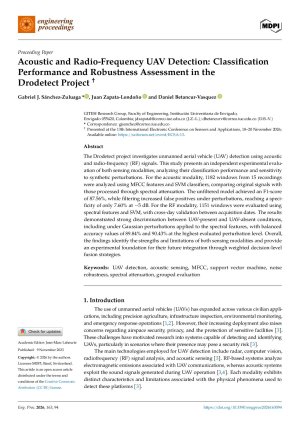
Acoustic and Radio-Frequency UAV Detection: Classification Performance and Robustness Assessment in the Drodetect Project

Gabriel Jaime Sanchez-Zuluaga 1
Juan David Zapata-Londoño 1
D. Betancur-Vasquez 1
1. Faculty of Engineering, GITESI Research Group, Institución Universitaria de Envigado, Envigado 055420, Colombia
Abstract
The increasing presence of unmanned aerial vehicles (UAVs) in urban, industrial, and critical infrastructure environments has created a need for detection systems capable of operating reliably under diverse environmental conditions. Approaches based on a single detection technique typically exhibit limitations associated with environmental noise, lighting variations, or communication signal loss, thereby affecting their identification and tracking capabilities.
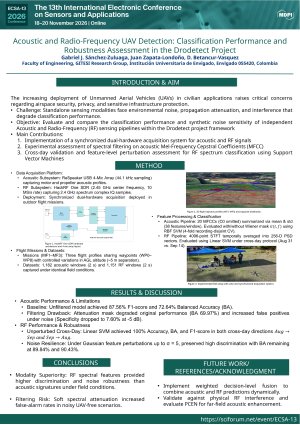
This paper presents a low-cost, multisensor architecture for UAV detection by integrating data from acoustic, radio frequency (RF), and computer vision sensors. The proposed approach combines the strengths of each technique to increase system robustness and reduce the probability of false detections. Data captured by the different sensors is processed and fused to generate a unified representation of UAV activity, enabling identification even when one of the data sources experiences degradation or uncertainty.
The architecture is implemented on embedded systems, promoting local data processing and real-time operation. Acoustic detection identifies characteristic signatures produced by UAV propulsion systems, while RF monitoring facilitates the detection of communication patterns associated with UAVs. Additionally, computer vision algorithms contribute to the visual validation of detected targets.
The experimental evaluation considers various operational scenarios to analyze system performance in terms of detection accuracy, false alarm rate, response time, and computational resource consumption. Furthermore, the individual contribution of each sensing modality and the effect of the fusion strategy on overall system performance are investigated. The results allow for a comparison between single-sensor approaches and the proposed multisensor system, identifying the advantages and limitations of each configuration for real-time aerial monitoring applications.
Keywords
Unmanned aerial vehicles (UAVs)
Multisensor fusion
UAV detection
Embedded systems
Real-time processing
Manuscript
sciforum-196220engproc-163-00094.pdf
Poster
Poster.pdf
Liquefied Petroleum Gas (LPG) Leakage Detection using MQ Sensors with Tiny-ML Technology
Secure Communication Testbed for Industry 4.0: Classical and Post-Quantum Protection