Event submissions
Published
This submission belongs to the session S7. Wearable Sensors and Healthcare Applications of the event The 13th International Electronic Conference on Sensors and Applications
Published date
16 Nov, 2026
Academic Editor
 Jean-Marc Laheurte
Citation
Ayub Alam, Valentina Vit, Nicola Coppede, Textile Organic Electrochemical Transistor: Biosensors for Real-Time Physiological Biofluid Analysis, in Proceedings of The 13th International Electronic Conference on Sensors and Applications, 18 November–20 November 2026, MDPI: Basel, Switzerland
Share
Email
Facebook
Twitter
LinkedIn
Textile Organic Electrochemical Transistor: Biosensors for Real-Time Physiological Biofluid Analysis

Ayub Alam 1,2

Valentina Vit 2
Nicola Coppede 2
1. Department of Chemistry, Life Sciences and Environmental Sustainability, University of Parma, 43124 Parma, Italy
2. Institute of Materials for Electronics and Magnetism (IMEM-CNR), University of Parma, Parco Area delle Scienze, 37/A, 43124 Parma PR, Italy
Abstract
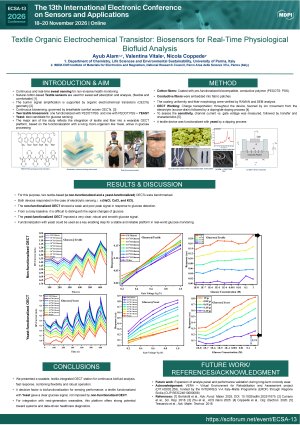
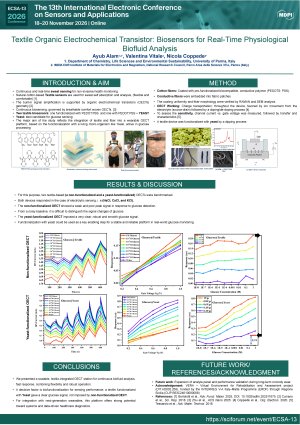
The development of wearable sensing technologies for real-time, non-invasive health monitoring is becoming increasingly reliant on developing more stable, adaptive, and flexible platforms. This study introduces a textile-integrated organic electrochemical transistor (OECT) sensor designed for regular monitoring of biofluid in physiologically dynamic environments. The device boosts comfortable and smooth on-body integration by utilizing inherent signal enhancement capacity of OECTs, along with the mechanical flexibility, breathability, and conformability of textile substrates. To improve ionic-to-electronic signal transduction, conductive polymers are incorporated into the PEDOT: PSS framework, which forms the basis of the sensing interface. Sweat and interstitial fluids are some examples of multifaceted biofluid environments where this design guarantees steady and consistent operation. Additionally, tailored functionalization techniques have been used to selectively enhance sensitivity toward particular biological analytes, enabling the platform to identify a wide variety of biomarkers with high precision. With great sensitivity, quick reaction times and superior temporal resolution, the system efficiently converts metabolic changes into measurable electrical impulses. For long-term wearable applications, operational stability, reproducibility, and robustness under changing physiological and environmental variables are given special attention. The devices’ dependability for real-world applications is demonstrated by their consistent and repeatable performance in simulated biofluid environments. Overall, this work offers a scalable and versatile textile-based bioelectronic sensing platform with great potential for integration into next-generation wearable technology and data-driven healthcare diagnostic tools.
Keywords
Textile-integrated bioelectronics
Sweat monitoring
Ionic-electronic transduction
PEDOT: PSS-based systems
Real-time electrochemical monitoring
Manuscript
Manuscript PDF.pdf
Poster
Manuscript PDF.pdf
Reliability of Machine Learning for Soil-Nutrient Estimation from Long-Term IoT Sensing: A Temporal-Validation and SHAP-Based Study under Tropical Conditions
Paper-pased device for nitrite monitoring fabricated via thermal transfer printing