Event submissions
Published
This submission belongs to the session S1. Chemo- and Biosensors of the event The 13th International Electronic Conference on Sensors and Applications
Published date
16 Nov, 2026
Academic Editor
 Stefano Mariani
Citation
Nektarios Kladis, Alexandros Tertikas, Dionysios Soulis, Anastasios Economou, Paper-pased device for nitrite monitoring fabricated via thermal transfer printing, in Proceedings of The 13th International Electronic Conference on Sensors and Applications, 18 November–20 November 2026, MDPI: Basel, Switzerland
Share
Email
Facebook
Twitter
LinkedIn
Paper-pased device for nitrite monitoring fabricated via thermal transfer printing

Nektarios Kladis 1
Alexandros Tertikas 1
Dionysios Soulis 1

Anastasios Economou 1
1. Department of Chemistry, National and Kapodistrian University of Athens, Athens 157 71, Greece
Abstract
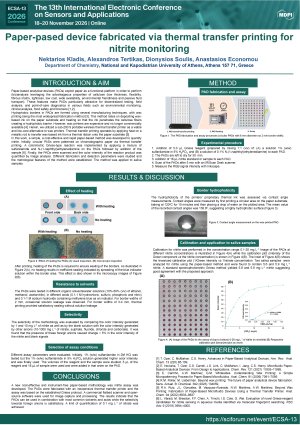
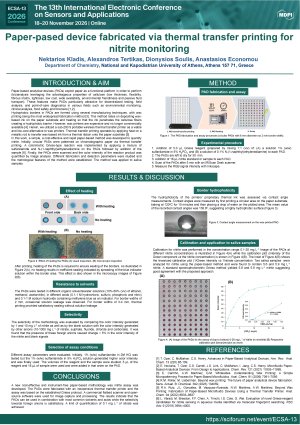
Paper-based analytical devices (PADs) exploit paper as a functional platform in order to perform (bio)analysis leveraging the advantageous properties of cellulose (low thickness, flexibility, fibrous matrix, lightness, low cost, wide availability, environmental friendliness and passive fluid transport). These features make PADs particularly attractive for decentralized testing, field analysis, and point-of-care diagnostics in various fields such as environmental monitoring, clinical analysis, food safety and forensics.
Hydrophobic borders in PADs are formed using several manufacturing techniques, with wax printing being the most widespread fabrication method. This method relies on depositing wax-based ink on the paper substrate and heating so that the ink penetrates the cellulose fibers creating an hydrophobic barrier. However, wax printers are expensive and no longer commercially available. Herein, we utilized a sub-200 $ portable wireless thermal transfer printer as a viable and low-cost alternative to wax printers. Thermal transfer printing operates by applying heat on a metallic rod to transfer wax-based ink from a thermal ribbon onto the paper substrate.
In this work, a simple, a cost-effective and rapid paper-based method was developed to quantify nitrite. Initially, circular PADs were patterned on chromatographic paper via thermal transfer printing. A colorimetric Griess-type reaction was implemented by applying a mixture of sulfanilamide and N-(1-naphthyl)ethylenediamine on the PADs followed by addition of the sample. Finally, the PADs were scanned and the color intensity of the reaction product was quantified by image analysis. Diffferent chemical and physical parameters were studied and the metrological features of the method were established. The method was applied to saliva and natural water samples.
Keywords
paper-pased device
thermal transfer printing
nitrite
colorimetry
Griess reaction
Manuscript
sciforum2026.pdf
Poster
sciforum2026.pdf
Textile Organic Electrochemical Transistor: Biosensors for Real-Time Physiological Biofluid Analysis
FT-IR micro-spectroscopy as a label-free biosensing approach for detecting protein secondary-structure alterations in intact cells