Event submissions
Published
This submission belongs to the session S9. Student Session of the event The 13th International Electronic Conference on Sensors and Applications
Published date
16 Nov, 2026
Academic Editor
 Stefano Mariani
Citation
Martina Pacifici, Roberta Meschini, Ines Delfino, FT-IR micro-spectroscopy as a label-free biosensing approach for detecting protein secondary-structure alterations in intact cells, in Proceedings of The 13th International Electronic Conference on Sensors and Applications, 18 November–20 November 2026, MDPI: Basel, Switzerland
Share
Email
Facebook
Twitter
LinkedIn
FT-IR micro-spectroscopy as a label-free biosensing approach for detecting protein secondary-structure alterations in intact cells

Martina Pacifici 1,2
Roberta Meschini 2

Ines Delfino 2
1. Department of Economics, Engineering, Society and Business, University of Tuscia, Viterbo, 01100, Italy
2. Department of Ecological and Biological Sciences, University of Tuscia, Viterbo, 01100, Italy
Abstract
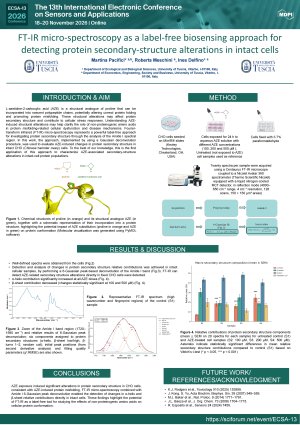
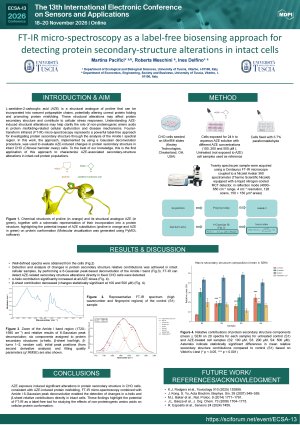
Protein misfolding is a key mechanism underlying cellular stress and many pathological conditions, which attracts a great research effort. In this field, directly monitoring protein conformational changes in intact cells is of utmost importance and remains challenging. Fourier-transform infrared (FT-IR) micro-spectroscopy has gained popularity in the field. In this work, we used FT-IR micro-spectroscopy to investigate protein structural alterations induced by L-azetidine-2-carboxylic acid (AZE), a structural analogue of proline that can be incorporated into proteins, potentially disrupting their proper folding, in intact Chinese hamster ovary (CHO) cells. In the study, CHO cells grown on MirrIR slides were treated with aqueous solutions of AZE at three concentrations (100, 200, and 500 μM) for 24 h. Treated cells, along with untreated cells used as control, were fixed with 3.7% paraformaldehyde and analyzed by FT-IR micro-spectroscopy. Spectra were collected from treated and untreated cells and processed using baseline correction and Savitzky-Golay smoothing. The Amide I region (1580-1720 cm⁻¹), which contains information about protein secondary structure, was deeply analyzed by applying a six-component Gaussian deconvolution model to estimate the relative contributions of protein secondary structure elements, such as α-helix, β-sheet, β-turn, and random coil. Following AZE exposure, the analysis revealed dose-dependent (as a function of concentration) changes in the Amide I band profile. Statistically significant variations in the relative contributions of α-helical and β-sheet structures were observed with respect to untreated controls, indicating alterations in protein conformation within the cellular environment. These findings demonstrate that FT-IR micro-spectroscopy combined with optimized Amide I deconvolution can provide a robust and label-free sensing platform for probing protein secondary-structure changes in intact cellular systems. It could be useful for designing biosensing applications focused on cellular protein conformational states and stress-induced structural perturbations.
Keywords
protein secondary structure
FT-IR
AZE
molecules induced stress
Manuscript
poster_ECSA2026.pdf
Poster
poster_ECSA2026.pdf
Paper-pased device for nitrite monitoring fabricated via thermal transfer printing
Flexible electronic platform for real-time monitoring of skin conductance and temperature