Event submissions
Published
This submission belongs to the session S7. Wearable Sensors and Healthcare Applications of the event The 13th International Electronic Conference on Sensors and Applications
Published date
16 Nov, 2026
Academic Editor
 Jean-Marc Laheurte
Citation
Rafaela Mihasi, Eleftheria Brigitta Souvatzi, Apostolos Apostolakis, Dimitris Barmpakos, Sofia Mavrikou, Eleni Makarona, Grigoris Kaltsas, Dopamine detection using CuO-coated Au interdigitated electrodes on a silicon substrate, in Proceedings of The 13th International Electronic Conference on Sensors and Applications, 18 November–20 November 2026, MDPI: Basel, Switzerland
Share
Email
Facebook
Twitter
LinkedIn
Dopamine detection using CuO-coated Au interdigitated electrodes on a silicon substrate

Rafaela Mihasi 1
Eleftheria Brigitta Souvatzi 1

Apostolos Apostolakis 1

Dimitris Barmpakos 1

Sofia Mavrikou 2

Eleni Makarona 3

Grigoris Kaltsas 1
1. microSENSES Laboratory, Department of Electrical and Electronics Engineering, University of West Attica, Athens, Greece
2. Laboratory of Cell Technology, Department of Biotechnology, Agricultural University of Athens, Athens, Greece
3. Institute of Nanoscience and Nanotechnology, National Centre of Scientific Research “Demokritos”, Athens, Greece
Abstract
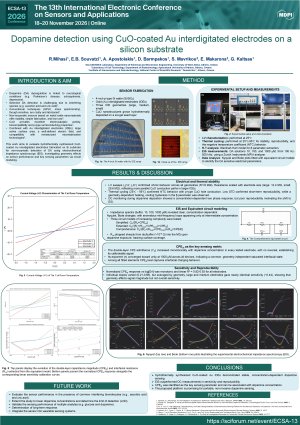
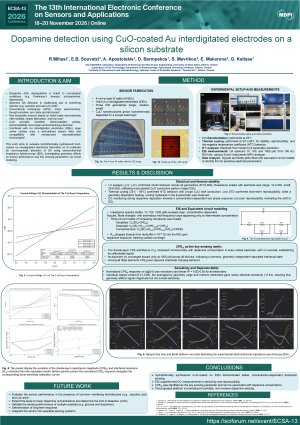
Dopamine is a crucial neurotransmitter, and its accurate detection is important for neurological diagnostics and biomedical research, as dopamine dysregulation has been associated with conditions such as Parkinson’s disease, schizophrenia, and depression. In this work, CuO-coated gold interdigitated electrodes (IDEs) fabricated on a silicon substrate were investigated as non-enzymatic electrochemical sensors for dopamine detection. The CuO nanostructures, which are the active layer of the device, were synthesized by a hydrothermal process and deposited onto the sensing region between the electrode fingers following standard lithographic steps. Several IDE geometries were evaluated in order to assess the influence of electrode dimensions on sensor response. Prior to dopamine measurements, current-voltage characterization at room temperature and under controlled thermal cycling confirmed the electrical stability and reproducibility of the devices. Dopamine sensing was performed at concentrations of 10, 100, and 1000 μM in both buffered and unbuffered conditions using DC and AC electrical characterization methods. Impedance measurements were acquired over the frequency range of 100 Hz to 500 kHz and analysed using three equivalent circuit models of increasing complexity. The simplest model accounted for the geometric capacitance, solution resistance, and interfacial double-layer response, while the more detailed models incorporated the CuO film contribution and additional polarization effects. The results showed a clear dependence of the sensor response on both dopamine concentration and measurement frequency. The most detailed circuit model provided the best description of the intermediate-frequency behaviour, suggesting competing adsorption processes at the sensor interface. DC measurements revealed an initial concentration-dependent response followed by a rapid transition, possibly associated with the formation of a dopamine-derived surface layer. Overall, the CuO-coated Au IDE sensors exhibited a stable and concentration-dependent electrical response, demonstrating their potential for dopamine sensing in biologically relevant environments.
Keywords
Dopamine sensing
CuO nanostructures
interdigitated electrodes
electrochemical impedance spectroscopy
Manuscript
ECSA-13_Dopamine_Mihasi.pdf
Poster
ECSA-13_Dopamine_Mihasi.pdf
Flexible electronic platform for real-time monitoring of skin conductance and temperature
Evaluation of a custom-made ELISA-based prototype under thermal exposure using Gram-negative and Gram-positive bacterial models