Event submissions
Published
This submission belongs to the session S7. Wearable Sensors and Healthcare Applications of the event The 13th International Electronic Conference on Sensors and Applications
Published date
16 Nov, 2026
Academic Editor
 Jean-Marc Laheurte
Citation
Eleftheria Brigitta Souvatzi, Apostolos Apostolakis, Tzoulian Koutsis, Polyxeni Papazoglou, Sofia Mavrikou, Grigoris Kaltsas, Evaluation of a custom-made ELISA-based prototype under thermal exposure using Gram-negative and Gram-positive bacterial models, in Proceedings of The 13th International Electronic Conference on Sensors and Applications, 18 November–20 November 2026, MDPI: Basel, Switzerland
Share
Email
Facebook
Twitter
LinkedIn
Evaluation of a custom-made ELISA-based prototype under thermal exposure using Gram-negative and Gram-positive bacterial models

Eleftheria Brigitta Souvatzi 1

Apostolos Apostolakis 1
Tzoulian Koutsis 1
Polyxeni Papazoglou 2

Sofia Mavrikou 3

Grigoris Kaltsas 1
1. microSENSES Laboratory, Department of Electrical and Electronics Engineering, University of West Attica, Athens, Greece
2. Laboratory of Environmental Biotechnology, Department of Biotechnology, Agricultural University of Athens, Athens, Greece
3. Laboratory of Cell Technology, Department of Biotechnology, Agricultural University of Athens, Athens, Greece
Abstract
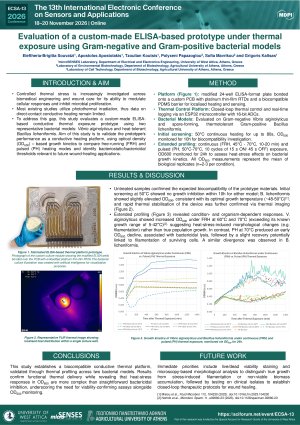
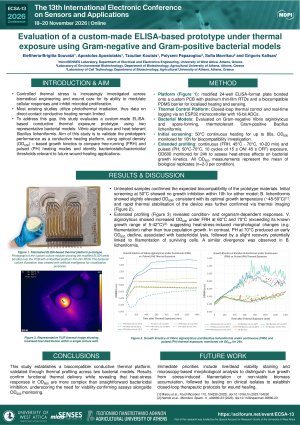
Heat shock effects on cells and bacteria is increasingly investigated across biomedical and industrial fields due to its ability to modulate cellular responses and inhibit microbial growth. Applications such as wound therapy, tumour ablation, catheter and surface disinfection rely on controlled heating, yet most studies use photothermal or autoclave-based methods, leaving limited data on direct-contact conductive heating. To address this gap, two representative bacterial models were selected: Vibrio alginolyticus (Gram-negative), a heat-sensitive bacterium with a growth temperature range similar to that of E. coli, which is commonly encountered in clinical settings, and Bacillus licheniformis (Gram-positive) which is a spore-forming and heat-tolerant model. For this study, a custom ELISA-based thermal exposure prototype was developed using a specially designed electronic circuit with integrated PT100 RTDs and a modified 24-well ELISA plate sealed with PDMS to ensure biocompatibility. Controlled heating experiments were performed at 50°C for up to 80s. Bacterial growth and short-term biocompatibility were assessed by OD600 measurements over a 10h period.
Preliminary results showed comparable growth kinetics between treated and untreated cultures, indicating that the platform is compatible with short-term bacterial culture under controlled thermal exposure conditions. Exposure to 50°C for up to 80s did not significantly inhibit bacterial growth within the tested timeframe. B. licheniformis exposed showed slightly elevated OD600 values at 10h, which is consistent with its ability to tolerate elevated temperatures and confirms rapid thermal stabilisation of the device. In conclusion, this preliminary evaluation demonstrates that the custom thermal exposure platform is functional, biocompatible and capable of supporting bacterial cultures during controlled heating experiments. Ongoing work includes systemic temperature-time profiling and long-term culture studies to identify bacteriostatic and bactericidal thresholds. The system holds potential for diverse future applications, including wound-infection studies, catheter or surface disinfection and broader thermal-inactivation assessment.
Keywords
conductive heating
bacterial viability
thermal exposure platform
biocompatibility.
Manuscript
Souvatzi-ECSA_13th - Evaluation of a custom-made ELISA-based prototype under thermal exposure using Gram-negative and Gram-positive bacterial models.pdf
Poster
Souvatzi-ECSA_13th - Evaluation of a custom-made ELISA-based prototype under thermal exposure using Gram-negative and Gram-positive bacterial models.pdf
Dopamine detection using CuO-coated Au interdigitated electrodes on a silicon substrate
A Self-biased Barium Hexagonal Ferrite-Nickel Zinc Ferrite Composite and Evidence for Strong Zero-Bias Magneto-electric Effects in a Bilayer With PZT