Event submissions
Published
This submission belongs to the session S2. Physical Sensors of the event The 13th International Electronic Conference on Sensors and Applications
Published date
16 Nov, 2026
Academic Editor
 Jean-Marc Laheurte
Citation
Sabita Acharya, Sujoy Saha, Raman Mishra, Rao Bidthanapally, Menka Jain, Michel R. Page, Gopalan Srinivasan, A Self-biased Barium Hexagonal Ferrite-Nickel Zinc Ferrite Composite and Evidence for Strong Zero-Bias Magneto-electric Effects in a Bilayer With PZT, in Proceedings of The 13th International Electronic Conference on Sensors and Applications, 18 November–20 November 2026, MDPI: Basel, Switzerland
Share
Email
Facebook
Twitter
LinkedIn
A Self-biased Barium Hexagonal Ferrite-Nickel Zinc Ferrite Composite and Evidence for Strong Zero-Bias Magneto-electric Effects in a Bilayer With PZT

Sabita Acharya 1

Sujoy Saha 1,2
Raman Mishra 3
Rao Bidthanapally 1
Menka Jain 3
Michel R. Page 4

Gopalan Srinivasan 1
1. Physics Department, Oakland University, Rochester, MI 48309, USA
2. Department of Basic Sciences, School of Sciences and Humanities, SR University, Warangal 506371, India.
3. Department of Physics, University of Connecticut, Storrs, CT 06269, USA
4. Materials and Manufacturing Directorate, Air Force Research Laboratory, Wright- Patterson Air Force Base, Dayton, Ohio 45433, USA
Abstract
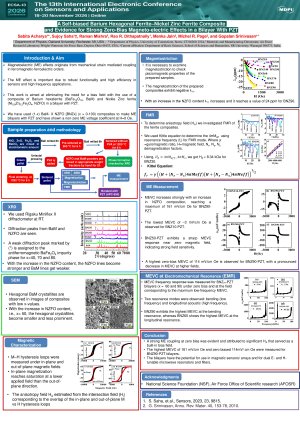
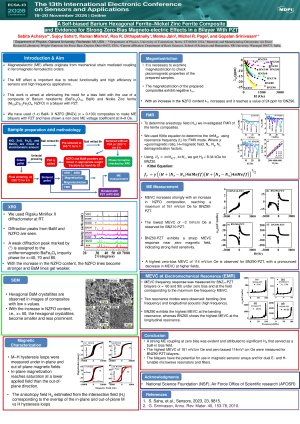
Ferromagnetic-ferroelectric composites are capable of converting a magnetic field into an electrical response that is facilitated by the piezoelectric response in the ferroelectric to the transfer of strain due to magnetostriction in the ferromagnetic phase. Such magneto-electric (ME) composites have potential for use as room-temperature magnetic field sensors for a variety of applications, such as medical imaging. An important technical challenge to overcome for such use is the need for a bias magnetic field since the piezomagnetic coefficient for most ferromagnets is very small under zero bias. In this work, we eliminate the need for an external bias with the use of a self-biased ferromagnetic phase with PZT. The ferromagnetic phase consisted of hexagonal barium ferrite (BaFe12O19, BaM) with very high magneto-crystalline anisotropy HA ~ 18 kOe and nickel-zinc spinel ferrite (Ni0.8Zn0.2Fe204 ,NZFO) with high magnetostriction, -30 ppm, essential for strong ME response.
Composites with (100-x) wt% BaM and x wt% NZFO were prepared by ceramic processing techniques and were found to be free of any impurity by x-ray diffraction. The composites has in-plane anisotropy field (HA) ranging from 4.8 to 8.3 kOe, which decreased as NZFO content was increased. The magnetostriction increased with x to -25 ppm. The ME response of PZT bilayers was evaluated by the MEVC at low frequency and electromechanical resonance.
A strong, x-dependent enhancement in MEVC was observed in the bilayers, with a maximum MEVC of 161 mV/cm Oe at 100 Hz and ~ 6 V/cm Oe at 10.6 kHz bending resonance for x = 90. The corresponding zero-bias MEVC values were 114 mV/cm Oe and 3.6 V/cm Oe, respectively. The results of our studies demonstrate that bilayers of PZT and BaM-NZFO composites can potentially eliminate the need for an external DC bias, enabling self-biased magnetic-field sensing for medical imaging and energy-harvesting applications.
Keywords
Magnetoelectric coupling
self-biased operation
composite
magnetic field sensors
Manuscript
ECSA_Poster_pdf.pdf
Poster
ECSA_Poster_pdf.pdf
Evaluation of a custom-made ELISA-based prototype under thermal exposure using Gram-negative and Gram-positive bacterial models
Fiber-tip Microsphere Interferometric Sensor for Temperature Monitoring in liquids