Event submissions
Published
This submission belongs to the session S2. Physical Sensors of the event The 13th International Electronic Conference on Sensors and Applications
Published date
16 Nov, 2026
Academic Editor
 Jean-Marc Laheurte
Citation
Susan Ximena Mendoza-Trejo, Yamil Alejandro Zúñiga-Avalos, Yadira Aracely Fuentes-Rubio, Rene Fernando Domínguez-Cruz, Arturo Castillo-Guzman, Fiber-tip Microsphere Interferometric Sensor for Temperature Monitoring in liquids, in Proceedings of The 13th International Electronic Conference on Sensors and Applications, 18 November–20 November 2026, MDPI: Basel, Switzerland
Share
Email
Facebook
Twitter
LinkedIn
Fiber-tip Microsphere Interferometric Sensor for Temperature Monitoring in liquids

Susan Ximena Mendoza-Trejo 1
Yamil Alejandro Zúñiga-Avalos 1

Yadira Aracely Fuentes-Rubio 1

Rene Fernando Domínguez-Cruz 1

Arturo Castillo-Guzman 2
1. Multidisciplinary Academic Unit Reynosa-Rodhe, Autonomous University of Tamaulipas, Reynosa, Tamaulipas 88779, Mexico
2. Faculty of Physical and Mathematical Sciences, Autonomous University of Nuevo León, San Nicolás de los Garza, Nuevo León 66455, Mexico
Abstract
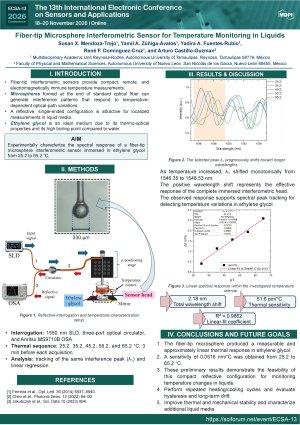
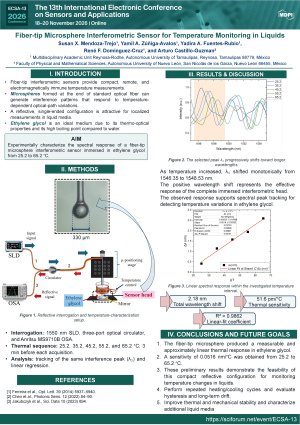
Fiber-tip interferometric sensors have been investigated for temperature measurements because they can be fabricated using standard optical fibers and interrogated through simple optical setups. Among these structures, microsphere-based interferometers provide a compact sensing element that can be easily fabricated by fiber fusion techniques whose spectral response is affected by temperature-dependent optical path variations. This work presents an experimental characterization of a fiber-tip microsphere interferometric sensor immersed in ethylene glycol. The sensing element consisted of a microsphere formed at the end of a standard single-mode optical fiber. The reflected spectrum was acquired using a super-luminescent laser diode, an optical circulator, and an optical spectrum analyzer. The sensor was immersed in ethylene glycol and subjected to temperatures ranging from 25.2 °C to 65.2 °C. The thermal response was evaluated from the spectral displacement of a selected interference peak. As the temperature increased, the monitored interference peak exhibited a progressive wavelength shift toward longer wavelengths. A linear fit of wavelength versus temperature yielded a sensitivity of 0.0516 nm/°C and a coefficient of determination of 0.98 within the investigated temperature interval. The obtained results indicate that the proposed microsphere interferometric structure can detect temperature variations in ethylene glycol through spectral peak tracking. These preliminary findings support further investigation of this sensing configuration and its characterization in liquid media.
Keywords
fiber optic sensor
microsphere sensor
temperature measurement
ethylene glycol
interferometric sensor
reflective configuration.
Manuscript
Fiber-tip_Microsphere_ECSA13_Poster ver2.pdf
Poster
Sciforum-196257.pdf
IMG_2915.mp4
A Self-biased Barium Hexagonal Ferrite-Nickel Zinc Ferrite Composite and Evidence for Strong Zero-Bias Magneto-electric Effects in a Bilayer With PZT
Control of sensitivity and selectivity of piezoelectric sensor coatings and their application in assessing the content of petroleum products in sand