Event submissions
Published
This submission belongs to the session S1. Chemo- and Biosensors of the event The 13th International Electronic Conference on Sensors and Applications
Published date
16 Nov, 2026
Academic Editor
 Stefano Mariani
Citation
Anastasiia Shuba, Vladimir Levchenko, Control of sensitivity and selectivity of piezoelectric sensor coatings and their application in assessing the content of petroleum products in sand, in Proceedings of The 13th International Electronic Conference on Sensors and Applications, 18 November–20 November 2026, MDPI: Basel, Switzerland
Share
Email
Facebook
Twitter
LinkedIn
Control of sensitivity and selectivity of piezoelectric sensor coatings and their application in assessing the content of petroleum products in sand

Anastasiia Shuba 1

Vladimir Levchenko 1
1. Department of Technology of Fats, Processes and Devices of Chemical and Food Production, Voronezh State University of Engineering Technologies, Revolution Avenue 19, 394036 Voronezh, Russia
Abstract
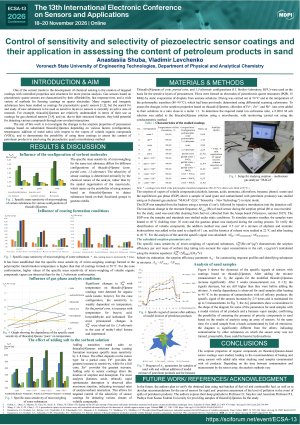
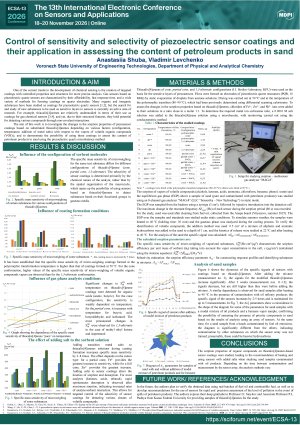
Studying the sorption properties of sensor coatings underlies the development of analytical methods. The ability to specifically modify the properties of sorbents in the sensor's sensitive layer enables the acquisition of additional analytical information from a sensor array. Substituted thiacalixarenes, which are capable of conformational transformations, were studied as sensor coatings. The addition of a transition metal salt to a thiacalixarenes solution and the effect of temperature on the sorption properties of piezoelectric sensor coatings based on them were investigated. The heat of conformational transformations was determined using differential scanning calorimetry, and the sorption of volatile compounds on thin coatings was studied using piezoelectric quartz microbalance. It was shown that adding iron and zinc salts to the solution in an equivalent ratio to thiacalixarenes alters the kinetics and efficiency of volatile compound sorption. The sorption coefficients and the maximum sorption of volatile compounds on thin thiacalixarenes-based coatings were estimated. It was also found that the higher the enthalpy of conformational transformation, the more significantly the sorption efficiency of lighter compounds increases during coating formation at temperatures of 80-90°C. The application of these coatings in assessing the presence of petroleum residues in beach sand after a fuel oil spill was demonstrated.
Keywords
Gas sensor
sorption
volatile compounds
analysis
petrolium
sand
Manuscript
Shuba A.A._2026.pdf
Poster
Shuba A.A._2026.pdf
Fiber-tip Microsphere Interferometric Sensor for Temperature Monitoring in liquids
Implementation of a Single-stage and Design of a Two-stage Power Amplifiers for S-band Applications with Wilkinson architecture