Event submissions
Published
This submission belongs to the session S4. Sensors and Artificial Intelligence of the event The 13th International Electronic Conference on Sensors and Applications
Published date
16 Nov, 2026
Academic Editor
 Francisco Falcone
Citation
Alexandra Gomez Caraveo, Miguel Bravo Zanoguera, Guillermo Galaviz, Jose Alejandro Amezquita Garcia, How Resolution Affects sEMG-Based Hand Gesture Recognition: A Machine Learning Preliminary Study, in Proceedings of The 13th International Electronic Conference on Sensors and Applications, 18 November–20 November 2026, MDPI: Basel, Switzerland
Share
Email
Facebook
Twitter
LinkedIn
How Resolution Affects sEMG-Based Hand Gesture Recognition: A Machine Learning Preliminary Study

Alexandra Gomez Caraveo 1

Miguel Bravo Zanoguera 2
Guillermo Galaviz 1
Jose Alejandro Amezquita Garcia 1
1. Faculty of Engineering, Autonomous University of Baja California, Mexicali, Baja California, 21280, Mexico
2. Department of Mechatronics, Polytechnic University of Baja California, Mexicali, Baja California, 21376, Mexico
Abstract
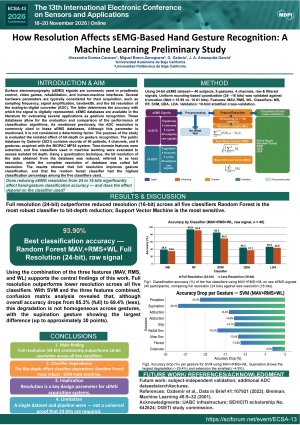
Surface electromyography (sEMG) signals are commonly used in prosthesis control, video games, rehabilitation, and human-machine interfaces. Several hardware parameters are typically considered for their acquisition, such as sampling frequency, signal amplification, bandwidth, and the bit resolution of the analog-to-digital converter (ADC). The latter determines the accuracy with which the signal is digitally represented. sEMG databases are available in the literature for evaluating several applications as gestiure recognition. These databases allow for the evaluation and comparison of the performance of classification algorithms. As mentioned previously, the ADC resolution is commonly cited in these sEMG databases. Although this parameter is mentioned, it is not considered a determining factor. The purpose of the study is evaluated the isolated effect of bit-depth on gesture recognition. The public database by Ozdemir (2021) contains records of 40 patients, 4 channels, and 9 gestures, acquired with the BIOPAC MP36 system. Time-domain features were extracted, and five classifiers used in machine learning were evaluated to assess isolated bit depth. Using a quantization technique, the bit resolution of the data obtained from the database was reduced, referred to as less resolution, while the complete resolution of database was called full resolution. The results showed that full resolution improves gesture classification, and that the random forest classifier had the highest classification percentage among the five classifiers used.
Keywords
sEMG
Bit depth
gesture recognition
Manuscript
poster_ECSA13_sEMG_bitdepth.pdf
Implementation of a Single-stage and Design of a Two-stage Power Amplifiers for S-band Applications with Wilkinson architecture
Behaviour Analysis of Selected Proximity Sensors in Extreme Incapacitating Ghost Obstacle Environments