Event submissions
Published
This submission belongs to the session S4. Sensors and Artificial Intelligence of the event The 13th International Electronic Conference on Sensors and Applications
Published date
16 Nov, 2026
Academic Editor
 Stefano Mariani
Citation
Katlego Rambau, Michael Ayomoh, Towards Adaptive Automotive Inspection: A Systematic Literature Review of RGB-D Sensors and Large Vision Models, in Proceedings of The 13th International Electronic Conference on Sensors and Applications, 18 November–20 November 2026, MDPI: Basel, Switzerland
Share
Email
Facebook
Twitter
LinkedIn
Towards Adaptive Automotive Inspection: A Systematic Literature Review of RGB-D Sensors and Large Vision Models

Katlego Rambau 1
Michael Ayomoh 1
1. Department of Industrial and Systems Engineering, University Of Pretoria, Pretoria, South Africa
Abstract
Introduction
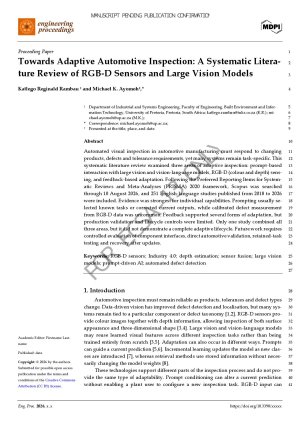
In the automotive manufacturing industry, automated defect detection is increasingly crucial as new product variants, shifting production standards and introduction of new defect variants necessitate adaptable quality inspection techniques. However, conventional vision systems are frequently task-specific and difficult to modify without machine learning knowledge. It remains unclear to what extent the current studies consider adaptability of large vision models, depth-based measurements and feedback retraining. To identify these gaps, this systematic literature review explores the state-of-the-art (SotA) in visual inspection systems.
Methods
Guided by the PRISMA 2020 framework, a systematic search was conducted in Scopus using thematic strings including automated visual inspection, RGB-D sensors, sensor fusion, large vision models, and prompt-driven techniques. Only English publications from 2018 to 2026 were included. Retrieved studies were screened by title, abstract, and keywords after deduplication and automated filtering. Information about sensor modalities, model architectures, the viability of edge deployment, and adaptability mechanisms in industrial settings was extracted.
Results
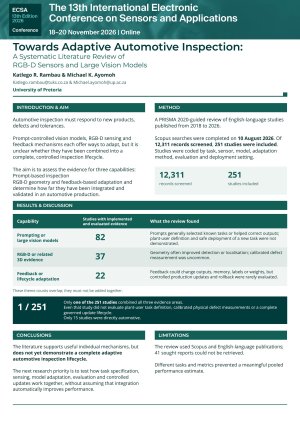
The initial 21,838 records were reduced to 12,246 unique items after filtering by date, language and removing duplicates. After screening titles and abstracts, 287 highly relevant studies were considered for full-text synthesis. The thematic analysis shows significant gaps in human-in-the-loop retraining and a strong focus on static sensor fusion and edge deployment. To fill these gaps, we synthesize the findings to propose a conceptual pipeline comprising 3 phases: (1) a prompt-driven natural language configuration interface, (2) a hierarchical RGB-D metrication and fusion module for spatial anomaly isolation, (3) an ongoing feedback-based retraining loop.
Conclusions
While current literature is rich in edge deployment and deep learning, it lacks strategies for dynamic, prompt-driven adaptability. This study contributes a novel human-guided conceptual pipeline. Compared to rigid conventional models, the proposed framework pushes automated inspection into an adaptive, sensor-driven system that can evolve continuously with changing automotive manufacturing requirements.
Keywords
RGB-D sensors
industry 4.0
depth estimation
sensor fusion
large vision models
prompt-driven AI
automated defect detection.
Manuscript
[Sciforum-192363] - [Manuscript PDF] - [Poster contribution - assigned].pdf
Poster
Katlego Rambau • Adaptive automotive inspection.pdf
360° Augmented Perception for Autonomous Haulage Systems in Surface Mining
An Artificial Intelligence Framework for Early Prediction of Diabetes using Hybrid Data Analytics