Event submissions
Published
This submission belongs to the session S4. Sensors and Artificial Intelligence of the event The 13th International Electronic Conference on Sensors and Applications
Published date
16 Nov, 2026
Academic Editor
 Stefano Mariani
Citation
Anushalin P. S, Balasubramaniam Doraiswamy, Hybrid CNN–Transformer U-Net for Robust Echocardiographic Segmentation in Myocardial Infarction Diagnosis, in Proceedings of The 13th International Electronic Conference on Sensors and Applications, 18 November–20 November 2026, MDPI: Basel, Switzerland
Share
Email
Facebook
Twitter
LinkedIn
Hybrid CNN–Transformer U-Net for Robust Echocardiographic Segmentation in Myocardial Infarction Diagnosis

Anushalin P. S 1
Balasubramaniam Doraiswamy 1
1. Department of Biomedical Engineering, Vel Tech Rangarajan Dr.Sagunthala R&D Institute of Science and Technology, Chennai, India
Abstract
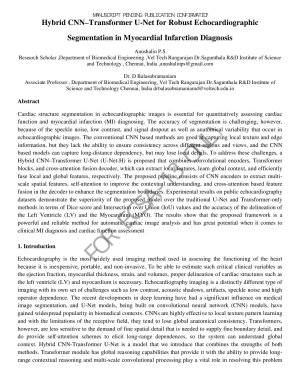
Cardiac structure segmentation in echocardiographic images is essential for quantitatively assessing cardiac function and myocardial infarction (MI) diagnosing. The accuracy of segmentation is challenging, however, because of the speckle noise, low contrast, and signal dropout as well as anatomical variability that occur in echocardiographic images. The conventional CNN based methods are good at capturing local texture and edge information, but they lack the ability to ensure consistency across different regions and views, and the CNN based models can capture long-distance dependency, but may lose local details. To address these challenges, a Hybrid CNN–Transformer U-Net (U-Net-H) is proposed that combines convolutional encoders, Transformer blocks, and cross-attention fusion decoder, which can extract local features, learn global context, and efficiently fuse local and global features, respectively. The proposed pipeline consists of CNN encoders to extract multi-scale spatial features, self-attention to improve the contextual understanding, and cross-attention based feature fusion in the decoder to enhance the segmentation boundaries. Experimental results on public echocardiography datasets demonstrate the superiority of the proposed model over the traditional U-Net and Transformer-only methods in terms of Dice score and Intersection over Union (IoU) values and the accuracy of the delineation of the Left Ventricle (LV) and the Myocardium (MYO). The results show that the proposed framework is a powerful and reliable method for automatic cardiac image analysis and has great potential when it comes to clinical MI diagnosis and cardiac function assessment.
Keywords
CNN
Segmentation
Hybrid
Transformers
Unet
myocardium
Manuscript
[Sciforum-198202] - [Manuscript PDF] - [Poster contribution - file uploaded].pdf
Poster
Presentation Material_198202.pdf
An Artificial Intelligence Framework for Early Prediction of Diabetes using Hybrid Data Analytics
A Portable Internet of Things Enabled Occluso-Bitemeter for Quantitative Assessment of Masticatory Function and Remote Monitoring