Event submissions
Published
This submission belongs to the session S4. Sensors and Artificial Intelligence of the event The 13th International Electronic Conference on Sensors and Applications
Published date
16 Nov, 2026
Academic Editor
 Francisco Falcone
Citation
Jitendra Pandey, Explainable Machine Learning for Multi-Sensor Physiological Monitoring: Towards Trustworthy Early-Warning Systems, in Proceedings of The 13th International Electronic Conference on Sensors and Applications, 18 November–20 November 2026, MDPI: Basel, Switzerland
Share
Email
Facebook
Twitter
LinkedIn
Explainable Machine Learning for Multi-Sensor Physiological Monitoring: Towards Trustworthy Early-Warning Systems

Jitendra Pandey 1
1. Department of Computing and Electronics Engineering, Middle East College, Muscat, Oman (academic partnership with Coventry University, UK), Muscat 124, Oman
Abstract
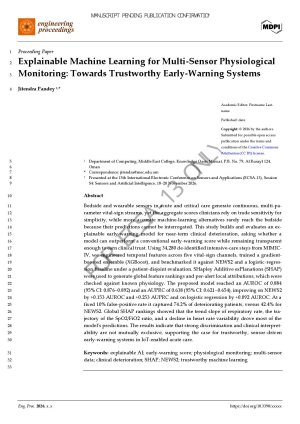
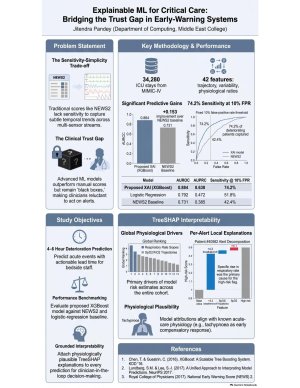
Abstract. Continuous multi-sensor monitoring (heart rate, SpO₂, respiration rate, blood pressure, and temperature from bedside and wearable sensors) generates extensive data streams. Clinicians will not respond to signals that they are unable to explore, posing a barrier to the clinical adoption of black-box ML early warning models. Place the gap: deep models are sensitive but opaque, whereas existing early warning scores (NEWS2) are interpretable but insensitive. Your contribution will be an explainable machine learning pipeline to help close the trust gap.
To predict clinical deterioration within a 4-6 hour window, an ensemble of gradient-boosted models (XGBoost or LightGBM) trained on multi-parameter physiological time series from a public ICU dataset (MIMIC-III/IV via PhysioNet is the obvious choice; alternatively, the eICU database). The feature engineering is carried out using the five vital-sign channels' sliding windows. Explainability layer: physiological plausibility is evaluated against NEWS2 criteria, with SHAP for global feature attribution and local explanations for each alarm. Logistic regression and NEWS2 are used as baseline comparisons.
Provide a qualitative conclusion based on the SHAP analysis (for example, respiratory rate and SpO2 trend dominating attributions, consistent with clinical literature and reviewers' validation), sensitivity at a clinically acceptable false-alarm rate, and AUROC and AUPRC vs baselines. Explainable models pave the way for dependable implementation in IoT-enabled patient monitoring by achieving equivalent or superior traditional ratings while providing clinically acceptable alarm explanations.
Keywords
Sensor Networks
Artificial Intelligence
Explainable Models
Manuscript
[Sciforum-196061] - [Manuscript PDF] - [Poster contribution - file uploaded].pdf
Poster
Explainable_ML_MultiSensor_Physiological_Monitoring_MDPI poster.pdf
A Portable Internet of Things Enabled Occluso-Bitemeter for Quantitative Assessment of Masticatory Function and Remote Monitoring
Interference sensor with a robust 3-stage noise-resilient algorithm for fringes pattern analysis