Event submissions
Published
This submission belongs to the session S1. Chemo- and Biosensors of the event The 13th International Electronic Conference on Sensors and Applications
Published date
16 Nov, 2026
Academic Editor
 Stefano Mariani
Citation
Maksim Kopylov, Ruslan Umarkhanov, Alexey Berestovoy, Anastasiia Shuba, Natalia Zabara, Korneeva O.S, Optimization of purification modes and evaluation of the degree of purification of sunflower protein concentrates using piezoelectric sensors, in Proceedings of The 13th International Electronic Conference on Sensors and Applications, 18 November–20 November 2026, MDPI: Basel, Switzerland
Share
Email
Facebook
Twitter
LinkedIn
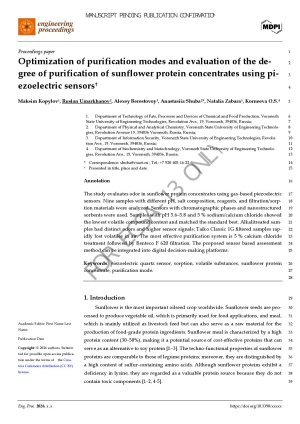
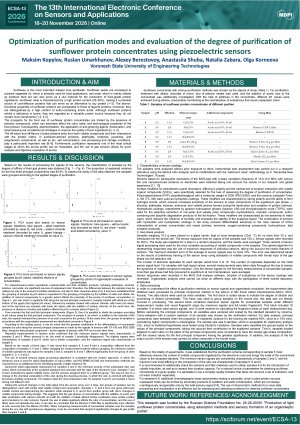
Optimization of purification modes and evaluation of the degree of purification of sunflower protein concentrates using piezoelectric sensors

Maksim Kopylov 1
Ruslan Umarkhanov 2
Alexey Berestovoy 3

Anastasiia Shuba 2
Natalia Zabara 1
Korneeva O.S 4
1. Department of Technology of Fats, Processes and Devices of Chemical and Food Production, Voronezh State University of Engineering Technologies, Revolution Ave., 19, Voronezh, 394036, Russia
2. Department of Physical and Analytical Chemistry, Voronezh State University of Engineering Technologies, Revolution Avenue 19, 394036 Voronezh, Russia
3. Department of Information Security, Voronezh State University of Engineering Technologies, Revolution Ave., 19, Voronezh, 394036, Russia
4. Department of biochemistry and biotechnology, Voronezh State University of Engineering Technologies, Revolution Ave., 19, Voronezh, 394036, Russia
Abstract
This study examines protein purification modes at various facilities and evaluates the odor of light sunflower protein concentrates obtained with different purification schemes using an array of gas-based chemical piezoelectric sensors. Nine protein concentrate samples with varying pH, salt composition, added reagent type, and the use of filter or sorption materials were analyzed. Volatile compounds emitted from the protein samples were recorded using sensors coated with chromatographic phases and nanostructured sorbents. During the study, several sensors in the array, the method for feeding volatile compounds into the detection cell, and the sorption time of the volatile protein fraction were replaced. Based on the sensor output data, it was established that the minimum content of volatile compounds detected by the sensors is typical for samples with a pH of 5.6-5.8 and treatment with 5% sodium or calcium chloride. These samples are closest to the accepted standard. Samples treated with alkali exhibited distinct odor profiles and increased overall sensor signals, while protein samples filtered with a Taiko Classic 1G filter exhibited a rapid decrease in volatile compound content when exposed to air. The most effective system for sunflower protein concentrate purification, based on sensory analysis, is treatment with 5% calcium chloride followed by filtration through a Benteco F 620 filter. Therefore, the applied sensor-based protein purification quality assessment system will enable the integration of purification decision-making into digital platforms.
Keywords
piezoelectric quartz sensors
sunflower protein
protein concentrate
volatile compounds
sorption
purification
smart agriculture
Manuscript
[Sciforum-192384] - [Manuscript PDF] - [Poster contribution - assigned].pdf
Poster
KOpylov_2026.pdf
MRI-Based Automated Multi-Class Brain Tumor Classification using Deep Convolutional Models
Aptamer-Based Nanozyme Self-Validating Electrochemiluminescence/Chemiluminescence Biosensor for Sensitive Detection of Aflatoxin B₁