Event submissions
Published
This submission belongs to the session S3. Sensor Networks, IoT, Smart Cities and Health Monitoring of the event The 13th International Electronic Conference on Sensors and Applications
Published date
16 Nov, 2026
Academic Editor
 Stefano Mariani
Citation
David Humberto Cárdenas Villacrés, Holger Jorge Santillan Carranza, Gregorio Jimenez, Erick Andrade, An Autonomous Localized IoT Framework for Continuous Non-Invasive Physiological Telemetry and Geodetic Animal Kinematics, in Proceedings of The 13th International Electronic Conference on Sensors and Applications, 18 November–20 November 2026, MDPI: Basel, Switzerland
Share
Email
Facebook
Twitter
LinkedIn
An Autonomous Localized IoT Framework for Continuous Non-Invasive Physiological Telemetry and Geodetic Animal Kinematics

David Humberto Cárdenas Villacrés 1
Holger Jorge Santillan Carranza 1
Gregorio Jimenez 1
Erick Andrade 1
1. Department of Telecommunications Engineering, Universidad Politécnica Salesiana, Guayaquil Campus, Guayaquil, 090101, Ecuador
Abstract
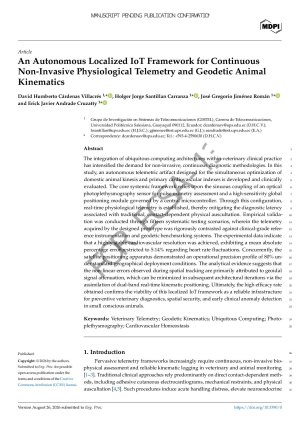
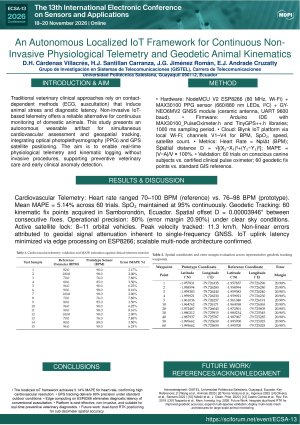
The integration of ubiquitous computing architectures within veterinary clinical practice has intensified the demand for non-invasive, continuous diagnostic methodologies. In this study, an autonomous telemetric artifact designed for the simultaneous optimization of domestic animal kinesis and primary cardiovascular indexes is developed and clinically evaluated. The core systemic framework relies upon the sinuous coupling of an optical photoplethysmography sensor for pulse oximetry assessment and a high-sensitivity global positioning module governed by a central microcontroller. Through this configuration, real-time physiological telemetry is established, thereby mitigating the diagnostic latency associated with traditional, contact-dependent physical auscultation.
Empirical validation was conducted through fifteen systematic testing scenarios, wherein the telemetry acquired by the designed prototype was rigorously contrasted against clinical-grade reference instrumentation and geodetic benchmarking systems. The experimental data indicate that a highly stable cardiovascular resolution was achieved, exhibiting a mean absolute percentage error restricted to 5.14% regarding heart rate fluctuations. Concurrently, the satellite positioning apparatus demonstrated an operational precision profile of 80% under standard geographical deployment conditions.
The analytical evidence suggests that the non-linear errors observed during spatial tracking are primarily attributed to geoidal signal attenuation, which can be minimized in subsequent architectural iterations via the assimilation of dual-band real-time kinematic positioning. Ultimately, the high efficacy rate obtained confirms the viability of this localized IoT framework as a reliable infrastructure for preventive veterinary diagnostics, spatial security, and early clinical anomaly detection in small conscious animals.
Keywords
Veterinary Telemetry
Geodetic Kinematics
Ubiquitous Computing
Photoplethysmography
Cardiovascular Homeostasis
Manuscript
[Sciforum-196031] - [Manuscript PDF] - [Poster contribution - file uploaded].pdf
Poster
poster_ECSA13_IoT_Animal_Telemetry.pdf
video1357286074.mp4
Aptamer-Based Nanozyme Self-Validating Electrochemiluminescence/Chemiluminescence Biosensor for Sensitive Detection of Aflatoxin B₁
Investigation of Features of Three Wearable PPG Multi-Sensors for Measurement in Low Magnetic Field MRI Tomograph