Event submissions
Published
This submission belongs to the session S3. Sensor Networks, IoT, Smart Cities and Health Monitoring of the event The 13th International Electronic Conference on Sensors and Applications
Published date
16 Nov, 2026
Academic Editor
 Stefano Mariani
Citation
Lopamudra Samal, Saurabh Kumar, Kamalakanta Mahapatra, An Energy- and Area-Efficient Modified Blowfish Encryption Scheme for Secure Healthcare IoT Sensor Nodes, in Proceedings of The 13th International Electronic Conference on Sensors and Applications, 18 November–20 November 2026, MDPI: Basel, Switzerland
Share
Email
Facebook
Twitter
LinkedIn
An Energy- and Area-Efficient Modified Blowfish Encryption Scheme for Secure Healthcare IoT Sensor Nodes

Lopamudra Samal 1
Saurabh Kumar 1
Kamalakanta Mahapatra 1
1. Electronics and Communication Engineering, National Institute of Technology, Rourkela, Rourkela 769008, India
Abstract
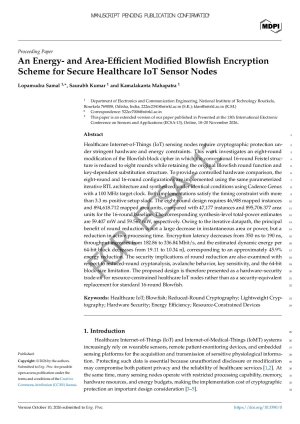
Data transmitted via healthcare Internet-of-Things (IoT) systems relies on resource-constrained sensing nodes that generate highly sensitive physiological and monitoring information. For securing such information, one must adopt encryption algorithms that provide security while still being efficient for low-power sensors. Traditional encryption algorithms may come at the expense of increased power consumption, area, and processing cost, making them less suitable for real-time healthcare applications.
This paper proposes an efficient modification of the Blowfish algorithm as a solution for secure transmission in healthcare IoT sensor networks. The reduced version is created by shrinking the number of Feistel iterations used in Blowfish from 16 to 8 rounds to reduce the processing cost. The proposed solution is simulated and analyzed against DES, AES, Blowfish, and RSA.
The results reveal that the Modified Blowfish approach provides a total power dissipation of 107.49 mW and an area occupation of 344,624.55 μm², which are less than those of the other approaches, such as DES, AES, Blowfish, and RSA. This demonstrates that the proposed approach can be used in applications that require energy-efficient healthcare IoT sensor nodes, healthcare monitoring systems, and medical sensing nodes.
The proposed Reduced-Round Modified Blowfish approach presents an efficient encryption algorithm for securing communication among healthcare IoT sensor nodes.
Keywords
Healthcare IoT
sensor-node security
lightweight cryptography
Modified Blowfish
secure sensor communication
resource-constrained devices.
Manuscript
[Sciforum-192453] - [Manuscript PDF] - [Poster contribution - assigned].pdf
Digitizing Legacy ECG Sensor Outputs for Automated Multi-Class Cardiac Abnormality Classification Using Deep Learning
Morse Code Translator Using an Infrared Sensor Through Eye-Blink Detection