Event submissions
Published
This submission belongs to the session S4. Sensors and Artificial Intelligence of the event The 13th International Electronic Conference on Sensors and Applications
Published date
16 Nov, 2026
Academic Editor
 Francisco Falcone
Citation
Timothy Malche, Embedded AI for Tennis Performance Analysis Using Racket-Mounted Inertial Sensors, in Proceedings of The 13th International Electronic Conference on Sensors and Applications, 18 November–20 November 2026, MDPI: Basel, Switzerland
Share
Email
Facebook
Twitter
LinkedIn
Embedded AI for Tennis Performance Analysis Using Racket-Mounted Inertial Sensors

Timothy Malche 1
1. Department of Computer Applications, Manipal University Jaipur, Jaipur, Rajasthan, India
Abstract
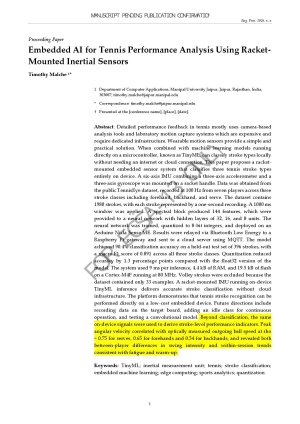
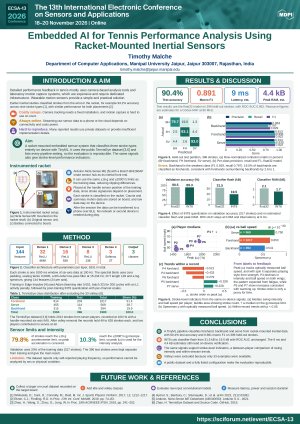
Introduction. Detailed performance feedback in tennis mostly uses camera-based analysis tools and laboratory motion capture systems which are expensive and require dedicated infrastructure. Wearable motion sensors provide a simple and practical solution. When combined with machine learning models running directly on a microcontroller, known as TinyML, can classify stroke types and profile players locally without needing an internet or cloud connection. This paper proposes a racket-mounted embedded sensor system that classifies five tennis stroke types and tracks longitudinal player style entirely on device.
Methods. A six-axis IMU combining a three-axis accelerometer and a three-axis gyroscope was mounted on a racket handle attachment compatible with standard rackets. Data was collected at 100 Hz from different participants across five stroke classes including forehand drive, backhand drive, flat serve, kick serve, and volley. Sliding-window feature extraction with a 500 ms window and 50% overlap was applied. A neural network was trained, quantized and deployed on low cost microcontroller. Stroke count, mean swing angular velocity, and shot-type distribution were logged to onboard flash and relayed via Bluetooth Low Energy.
Results. The model achieved 91% classification accuracy across all five stroke classes at an inference latency of 8 ms per window. The system sustained operation throughout a 90-minute session within power budget. By analyzing shot patterns across playing sessions, the system was able to distinguish players styles and shot selection preferences. The system achieved strong clustering.
Conclusions. A racket-mounted IMU running on-device TinyML inference delivers accurate stroke classification and actionable player analytics without cloud infrastructure. The platform supports per-session performance summaries and longitudinal style tracking for players at any level. Future directions include adding more classes and diverse player data, and integration with coach facing mobile dashboards.
Keywords
TinyML
Embedded AI
Sensors
Sports AI
Manuscript
[Sciforum-192187] - [Manuscript PDF] - [Poster contribution - assigned].pdf
Poster
ECSA-13_poster_tennis_stroke.pdf
Adaptive Sampling and Machine Learning-Based Soil Fertility Prediction Framework for Smart Agriculture Sensors