Event submissions
Published
This submission belongs to the session S3. Biosignal Processing of the event The 2nd International Conference on Bioengineering
Published date
16 Nov, 2026
Citation
Magdalena Czeleń, Eliasz Kańtoch, Temporal Speech Parameters and Relative Voice Signal Level as Potential Indicators of Cognitive Load and Psychomotor Fatigue: A Proof-of-Concept Study, in Proceedings of The 2nd International Conference on Bioengineering, Barcelona, 10 November–13 November 2026, MDPI: Basel, Switzerland
Share
Email
Facebook
Twitter
LinkedIn
Temporal Speech Parameters and Relative Voice Signal Level as Potential Indicators of Cognitive Load and Psychomotor Fatigue: A Proof-of-Concept Study

Magdalena Czeleń 1
Eliasz Kańtoch 1
1. Faculty of Electrical Engineering, Automatics, Computer Science and Biomedical Engineering, AGH University of Krakow,, Poland
Abstract
Introduction
Psychomotor fatigue and cognitive load may affect human performance and speech production. Voice analysis offers a potentially non-invasive approach to monitoring such changes. However, review studies have highlighted inconsistencies in findings concerning acoustic indicators of cognitive load [1–3]. This study aimed to preliminarily assess the usefulness of temporal speech parameters and relative voice signal level as complementary measures to conventional acoustic features.
Methods
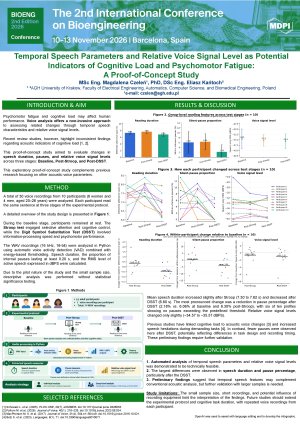
Thirty recordings from ten participants (six women and four men; aged 20–26 years) were analyzed. For each participant, recordings of the same sentence read aloud were obtained at three stages: baseline, after the Stroop test, and after the Digit Symbol Substitution Test (DSST). The recordings were acquired as 16-bit WAV files at a sampling rate of 16 kHz. Voice activity detection (VAD) based on energy thresholding was implemented in Python. Utterance duration, the proportion of internal pauses lasting at least 0.20 s, and the root mean square (RMS) level of active speech expressed in dBFS were calculated. The analysis was descriptive, without statistical significance testing.
Results
Mean utterance duration was 7.30 s at baseline, 7.62 s after the Stroop test, and 6.80 s after the DSST. The corresponding proportions of pauses were 6.08%, 6.30%, and 2.18%, respectively. Following the DSST, no pauses meeting the predefined criterion were detected in four participants. Mean RMS levels were −34.57, −35.19, and −35.57 dBFS, respectively.
Conclusions
These preliminary findings demonstrate the technical feasibility of automated analysis of short speech recordings and indicate variation in temporal speech parameters across measurement stages. However, the small sample size, fixed task order, and potential effects of sentence repetition prevent attributing the observed changes solely to psychomotor fatigue. Further measurements and improved control of recording conditions are required.
References
[1]SchewskiL.etal.(2025).PLOSONE,20(7),e0328833.doi:10.1371/journal.pone.0328833.
[2]PyfromM.etal.(2026).JournalofVoice,40(1),218–228.doi:10.1016/j.jvoice.2023.08.024.
[3]MacPhersonM.K.etal.(2017).JournalofVoice,31(4),504.e1–504.e9.doi:10.1016/j.jvoice.2016.10.021.
Keywords
voice analysis
cognitive load
psychomotor fatigue
temporal speech features
pause detection
relative voice signal level
Poster
BIOENG2026 - Poster presentation_CZELEN.pdf
Electric fields to stimulate the three-dimensional migration of transplantable donor cells in retina