Event submissions
Published
This submission belongs to the session S4. Biomedical Engineering and Biomaterials of the event The 2nd International Conference on Bioengineering
Published date
16 Nov, 2026
Contribution&Funding
Conceptualization,
[Barkın Başgül] ; [Salim Can Akyürek]
Methodology,
[Barkın Başgül] ; [Salim Can Akyürek]
Software,
[Barkın Başgül] ; [Salim Can Akyürek]
Formal analysis,
[Barkın Başgül]
Investigation,
[Barkın Başgül] ; [Salim Can Akyürek]
Visualization,
[Barkın Başgül] ; [Salim Can Akyürek]
Supervision,
[Salim Can Akyürek]
Funding: --
Citation
Barkın Başgül, Salim Can Akyürek, Development of an Open-Access Computational Simulator for Nanoparticle Drug Release and Tissue Penetration, in Proceedings of The 2nd International Conference on Bioengineering, Barcelona, 10 November–13 November 2026, MDPI: Basel, Switzerland
Share
Email
Facebook
Twitter
LinkedIn
Development of an Open-Access Computational Simulator for Nanoparticle Drug Release and Tissue Penetration

Barkın Başgül 1
Salim Can Akyürek 2
1. Department of Science, Wyoming Seminary College Preparatory School , Moosic, 18507, USA
2. Materials and Structural Analysis, Thermo Fisher Scientific, Ankara, 06810, Turkey (Türkiye)
Abstract
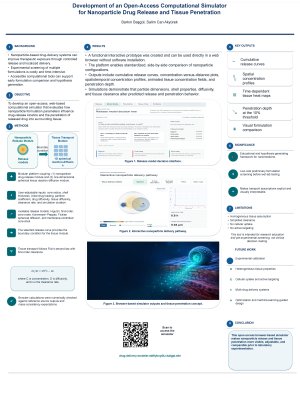
Background: Nanoparticle-based drug-delivery systems can improve therapeutic exposure through controlled drug release and localized delivery. However, experimentally testing multiple nanoparticle formulations is costly and time-intensive, creating a need for accessible computational tools that support preliminary formulation comparison and hypothesis generation.
Objective: To develop an open-access, web-based computational simulator that evaluates how nanoparticle formulation parameters influence drug-release kinetics and the penetration of released drug into surrounding tissue.
Methods: A modular simulation platform was developed to couple nanoparticle drug release with a one-dimensional spherical tissue reaction-diffusion model. Users can modify nanoparticle core radius, polymer-shell thickness, drug loading, partition coefficient, drug diffusivity, tissue diffusivity, clearance rate, and simulation duration. Six release formulations are available for comparison: Higuchi, first-order, zero-order, Korsmeyer–Peppas, Fickian spherical diffusion, and membrane-controlled core-shell models. The selected release curve provides the time-dependent inner boundary concentration for the tissue module, which solves Fick’s second law with a first-order clearance term. Outputs include cumulative release curves, spatial and temporal concentration profiles, animated tissue concentration fields, and penetration depth, defined as the distance at which tissue concentration falls below 10% of the nanoparticle-surface concentration. Browser calculations were numerically checked against reference outputs generated from the underlying source implementation.
Results: A functional interactive prototype was produced that permits standardized, side-by-side comparison of nanoparticle configurations without requiring software installation. The platform demonstrates how changes in particle dimensions, shell properties, diffusivity, and tissue clearance alter predicted release and penetration behavior. Integrated model documentation distinguishes numerically verified calculations from unsupported clinical or organ-specific interpretations.
Conclusion: This open-access, web-based accessible simulator provides an educational and hypothesis-generating framework for investigating nanoparticle drug-delivery design. It may support preliminary formulation screening and improve understanding of diffusion-controlled delivery mechanisms before laboratory experimentation. Future work will incorporate experimental calibration, heterogeneous tissue properties, cellular uptake, active targeting, multidrug systems, and optimization algorithms.
Keywords
Nanoparticle drug delivery
Controlled drug release
Tissue penetration
Computational modelling
Poster
BarkinBasgul_nanoparticle_poster_Bioengineering.pdf
Biomimetic Matrigel-Fibrin-GelMA Bioink and Geometric Anisotropy Synergistically Guide Skeletal Muscle Maturation in 3D Bioprinted Constructs
From Bioinnovation to Adoption: A Practical Translational Pathway