Event submissions
Published
This submission belongs to the session S4. Biomedical Engineering and Biomaterials of the event The 2nd International Conference on Bioengineering
Published date
16 Nov, 2026
Contribution&Funding
Conceptualization,
[ISMAIL AGIR]
Methodology,
[ISMAIL AGIR]
Software,
[ISMAIL AGIR]
Validation,
[ISMAIL AGIR]
Formal analysis,
[ISMAIL AGIR]
Investigation,
[ISMAIL AGIR]
Resources,
[ISMAIL AGIR]
Data curation,
[ISMAIL AGIR]
Writing - original draft,
[ISMAIL AGIR]
Writing - review,
[editing] ; [ISMAIL AGIR]
Visualization,
[ISMAIL AGIR]
Supervision,
[ISMAIL AGIR]
Project administration,
[ISMAIL AGIR]
Funding acquisition,
[ISMAIL AGIR]
Funding: --
Citation
ISMAIL AGIR, Fine-Tuning LLMs to Design Microfluidic Devices: Dataset Generation, in Proceedings of The 2nd International Conference on Bioengineering, Barcelona, 10 November–13 November 2026, MDPI: Basel, Switzerland
Share
Email
Facebook
Twitter
LinkedIn
Fine-Tuning LLMs to Design Microfluidic Devices: Dataset Generation

ISMAIL AGIR 1
1. Bioengineering, Istanbul Medeniyet University, Istanbul, Turkey (Türkiye)
Abstract
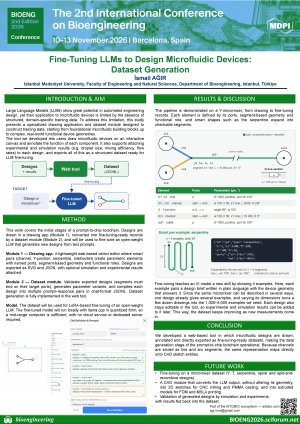
Large Language Models (LLMs) show great potential in automated engineering design, yet their application to microfluidic devices is limited by the absence of structured, domain-specific training data. To address this limitation, this study presents a specialized dataset generation tool designed to construct training data, starting from foundational microfluidic building blocks up to complex, real-world functional device geometries.
We developed the tool as a lightweight web-based application that operates similarly to standard vector design software. We built an intuitive canvas featuring smart shapes, including specialized channels, droplet generators, and mixers, and we integrated import and export capabilities for seamless workflow implementation. We chose SVG and JSON as the primary formats because they combine scalable visual representation with structured data that LLMs can easily parse and generate. Through this interactive interface, users can digitally recreate fundamental geometries from literature or their studies. Users design the device geometry and provide prompt-targeted descriptions specifying the functional roles of components like channels, junctions, and reservoirs. The second part of the tool compiles these user-provided designs into a structured dataset directly suitable for LLM fine-tuning.
In this study, we present a standardized pipeline that converts geometric layouts into fine-tuning-ready datasets, positioning our tool as a critical enabler for generative microfluidics. Ultimately, this work establishes the foundation required to transition from manual microfluidic design to autonomous, prompt-to-chip design.
Keywords
Microfluidic Devices
Large Language Models
Fine-Tuning Datasets
Generative Design
Vector Graphics
Lab-on-a-Chip Automation
Poster
BIOENG2026 - Poster .pdf
Hydrogels and Microgels as Building Blocks of Bioengineered Tissues
Precise Construction, Preparation, and Functional Regulation of Adsorbent Materials for Blood Purification