Event submissions
Published
This submission belongs to the session S4. Biomedical Engineering and Biomaterials of the event The 2nd International Conference on Bioengineering
Published date
16 Nov, 2026
Citation
Ana R. Domingues, Joana Silva, Alice Miranda, Sofia Martinho, Jorge Correia-Pinto, Bruno Esteves, Manuel F. Silva, José H. Correia, Sara Pimenta, Nitinol spring controlled by electromagnetic induction for biomedical applications, in Proceedings of The 2nd International Conference on Bioengineering, Barcelona, 10 November–13 November 2026, MDPI: Basel, Switzerland
Share
Email
Facebook
Twitter
LinkedIn
Nitinol spring controlled by electromagnetic induction for biomedical applications

Ana R. Domingues 1
Joana Silva 1
Alice Miranda 2,3
Sofia Martinho 2,3,4
Jorge Correia-Pinto 2,3,4
Bruno Esteves 1,5
Manuel F. Silva 1,5
José H. Correia 1,5
Sara Pimenta 1,5
1. CMEMS-UMinho, University of Minho, 4800-058 Guimarães, Portugal
2. Life and Health Sciences Research Institute (ICVS), School of Medicine, University of Minho, 4710‑057 Braga, Portugal
3. ICVS/3B’s—PT Government Associate Laboratory, Braga/Guimarães, Portugal
4. Pediatric Surgery Department, Hospital de Braga, Braga, Portugal
5. LABBELS—Associate Laboratory, Braga/Guimarães, Portugal
Abstract
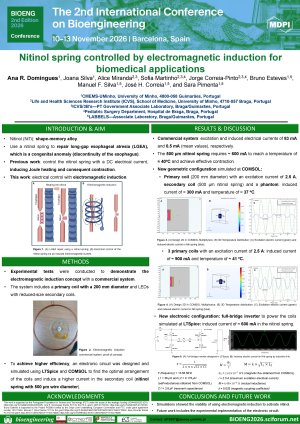
Introduction: Nitinol (NiTi) is a shape memory alloy with several biomedical applications. Very recently, we proposed to use a nitinol spring to repair long-gap esophageal atresia. We explored the electrical control of a nitinol spring through the application of DC electrical current, inducing Joule heating and consequent spring contraction. Here, in this work, we propose to control the nitinol spring with electromagnetic induction.
Methods: Experimental tests were conducted to demonstrate the electromagnetic induction concept with a commercial system. The half-wave electromagnetic induction system included a primary coil with approximately 200 mm in diameter and light-emitting diodes (LEDs) with reduced-size secondary coils. To achieve higher efficiency, a full-wave electronic circuit was custom-designed and simulated using LTspice and COMSOL Multiphysics to preview the optimal arrangement of the coils and to achieve a higher current induced in the secondary coil (nitinol spring).
Results and Discussion: The obtained results using the commercial system showed excitation and induced electrical currents of approximately 83 mA and 0.5 mA (mean value), respectively. A more optimized version must be developed to allow the control of the nitinol spring by electromagnetic induction, with the final goal of repairing long-gap esophageal atresia. Thus, we have designed and simulated an electronic circuit based on a full‑bridge configuration, which allowed us to obtain higher electrical currents by increasing the number of primary coils and implementing the inductive link resonance approach, optimizing the power transfer efficiency (PTE).
Conclusions: The simulations showed the viability of using electromagnetic induction to activate a nitinol spring. Future work includes the implementation and experimental testing (with solid phantoms) of the designed electronic circuit.
Keywords
Shape memory alloy
Bioelectronics
Poster
Poster_BIOENG2026_AnaDomingues.pdf
Intraoperative hyperspectral imaging and deep learning for vulvar cancer detection
Biomechanical Analysis of Handball Movements: Sex-Specific Differences and Evaluation of Pivot Point Estimation Techniques