Event submissions
Published
This submission belongs to the session S3. Biosignal Processing of the event The 2nd International Conference on Bioengineering
Published date
16 Nov, 2026
Citation
Takuma Saga, Norihiko Saga, Jun-ya Nagase, Toshiyuki Satoh, Hidekatsu Ito, Suguru N. Kudoh, Taro Maeda, A Leader–Follower Flexor System Using EMG-Based Motion Prediction for Remote Rehabilitation, in Proceedings of The 2nd International Conference on Bioengineering, Barcelona, 10 November–13 November 2026, MDPI: Basel, Switzerland
Share
Email
Facebook
Twitter
LinkedIn
A Leader–Follower Flexor System Using EMG-Based Motion Prediction for Remote Rehabilitation

Takuma Saga 1
Norihiko Saga 2
Jun-ya Nagase 3
Toshiyuki Satoh 4
Hidekatsu Ito 5
Suguru N. Kudoh 2
Taro Maeda 6
1. Department of Mechanical Systems Engineering, The University of Shiga Prefecture, Hikone, Shiga 522-0057, Japan
2. Department of Artificial Intelligence and Mechanical Engineering, School of Engineering, Kwansei Gakuin University, Sanda, Hyogo 669-1330, Japan
3. Department of Mechanical and Systems Engineering, Science and Technology, Ryukoku University, Otsu, Shiga 520-2194, Japan
4. Department of Intelligent Mechatronics, Faculty of Systems Science and Technology, Akita Prefectural University, Yurihonjo, Akita 015-0055, Japan
5. Faculty of Urban Science, Nagoya Dome-Mae Campus, Meijo University, Nagaoya, Aichi 461-8534, Japan
6. Department of Bioinformatic Engineering, Graduate School of Information Science and Technology, The University of Osaka, Suita, Osaka 565-0871, Japan
Abstract
Introduction:
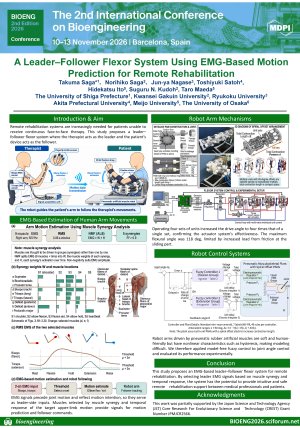
Remote rehabilitation systems are increasingly required to support patients who have difficulty receiving continuous face-to-face therapy. This study aims to develop a leader–follower flexor system for remote rehabilitation between therapists or physicians and patients. In the proposed concept, the therapist or physician acts as the leader, and the patient-side rehabilitation device acts as the follower.
Methods:
Electromyography signals are used as leader-side input signals because they appear before actual joint motion and can reflect motion intention. The muscles for EMG measurement are selected by considering muscle synergy and temporal response characteristics related to the target upper-limb motion. These selected EMG signals are used for motion prediction and as command signals for the follower system. The follower consists of a flexor mechanism driven by pneumatic artificial muscles reinforced with straight fibers. The actuator system is designed to provide flexibility, safety, and sufficient joint motion for rehabilitation assistance.
Results and Discussion:
The developed flexor system achieved a large joint driving angle comparable to that of the human arm. In preliminary experiments, the system flexed and extended in response to EMG signals obtained from human arm muscles, indicating that EMG-based control can reproduce intended upper-limb motion. The pneumatic artificial muscle mechanism also provides compliance, which is important for safe interaction with patients during rehabilitation.
Conclusions:
This study proposes an EMG-based leader–follower flexor system for remote rehabilitation. By selecting leader EMG signals based on muscle synergy and temporal response, the system has the potential to provide intuitive and safe rehabilitation support between medical professionals and patients in different locations.
This work was partially supported by the Japan Science and Technology Agency (JST) Core Research for Evolutionary Science and
Technology (CREST) Grant Number JPMJCR2566.
Keywords
artificial muscle
flexor system
fuzzy control
robot arm
Leader–Follower
Poster
BIOENG2026 - Poster_Sciforum-204333.pdf
Machine Learning vs Traditional Risk Scores for Predicting 30-Day In-Hospital Mortality in Upper Gastrointestinal Bleeding
Sugarcane bagasse: from the enzyme to the XOS production