Event submissions
Published
This submission belongs to the session S4. Biomedical Engineering and Biomaterials of the event The 2nd International Conference on Bioengineering
Published date
16 Nov, 2026
Citation
Haochen Han, Wei Chen, Kun Qian, Lin Huang, Fe Metal-Organic Framework-Derived Heterojunction for Metabolic Diagnosis of Thymic Epithelial Tumors, in Proceedings of The 2nd International Conference on Bioengineering, Barcelona, 10 November–13 November 2026, MDPI: Basel, Switzerland
Share
Email
Facebook
Twitter
LinkedIn
Fe Metal-Organic Framework-Derived Heterojunction for Metabolic Diagnosis of Thymic Epithelial Tumors

Haochen Han 1
Wei Chen 2

Kun Qian 2
Lin Huang 1
1. Chest Hospital, Shanghai Jiao Tong University School of Medicine, Shanghai Jiao Tong University, Shanghai 200030, China
2. Shanghai Jiao Tong University School of Biomedical Engineering, Shanghai Jiao Tong University, Shanghai 200030, China
Abstract
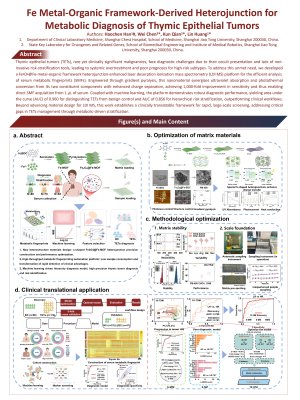
Introduction: Thymic epithelial tumors (TETs), including thymomas and thymic carcinomas, are the predominant neoplasms of the anterior mediastinum. High-risk TETs have poor outcomes because of invasion and metastasis. Current diagnosis relies on computed tomography and invasive biopsy, which have limited specificity and scalability. Serum metabolic profiling offers a minimally invasive alternative, but conventional organic matrices for matrix-assisted laser desorption/ionization mass spectrometry (MALDI-MS) cause substantial low-mass background and limited sensitivity.
Methods: An Fe-based metal-organic framework (Fe-MOF) was synthesized by a sonication-assisted water-bath method and partially pyrolyzed at 350-500 °C to generate Fe₃O₄@Fe-MOF heterojunctions. FM-450, produced at 450 °C, exhibited optimal analytical performance. Serum metabolic fingerprints (SMFs) were acquired by laser desorption/ionization mass spectrometry (LDI-MS) from 1 μL of serum from 163 patients with TETs and 80 benign controls (BCs). After spectral processing, machine-learning algorithms were used to construct diagnostic and risk-stratification models.
Results and Discussion: FM-450 combines the photothermal conversion efficiency of Fe₃O₄ nanoparticles with the ultraviolet absorption of the Fe-MOF framework to enhance the laser response. Its interfacial S-scheme heterojunction further promotes charge separation, thereby facilitating metabolite desorption and ionization. These synergistic properties increased metabolite signal intensities by up to 1,000-fold compared with CHCA and DHB, reduced low-mass background interference, and yielded coefficients of variation (CVs) of 4.1%-15.0%. Integration with an automated spotter enabled analysis within 14 s per sample, operational CVs below 10%, and an estimated matrix cost of $0.03 per test. The platform distinguished TETs from BCs (AUC = 0.960) and stratified high- and low-risk TETs (AUC = 0.856), exceeding imaging-based risk assessment (AUC = 0.627). Pathway analysis identified dysregulation of glycerolipid metabolism, the citrate cycle, and pyruvate metabolism.
Conclusions: Fe-MOF serves as both the structural precursor and ultraviolet-absorbing component of FM-450. Combined with Fe₃O₄-mediated photothermal conversion, the resulting heterojunction provides the functional basis for sensitive LDI-MS and enables rapid, high-throughput, minimally invasive metabolic diagnosis and risk stratification of TETs.
Keywords
thymic epithelial tumors;clinical diagnostics; risk stratification; heterojunction; mass spectrometry
Poster
Poster.pdf
Laser-Induced Graphene from Negra Andina potato peel: feasibility and structural characterization
Long-term follow-up after nanosurgery and bioengineering treatment for anterior cruciate ligament tears