Event submissions
Published
 10.3390/chemproc2026022159 (registering DOI)
This submission belongs to the session Session 2. Chemistry of Bioorganics, Medicinal and Natural Products of the event The 30th International Electronic Conference on Synthetic Organic Chemistry
Published date
18 Nov, 2026
Academic Editor
 Julio A. Seijas
Citation
Gheffar Kher al-deen Kara, Maya Zanouba, Haroun Ali, Yassan Taha, Deema Hassan, samar Dawooda, Sndous zydan, Mohammad Al-Shahna, Zainab Khadour, Variation in the photodegradability of a set of green carbon quantum dots towards aflatoxin B1: A study of photodegradation parameters, in Proceedings of The 30th International Electronic Conference on Synthetic Organic Chemistry, 5 November–19 November 2026, MDPI: Basel, Switzerland, doi: 10.3390/chemproc2026022159
Share
Email
Facebook
Twitter
LinkedIn
Variation in the photodegradability of a set of green carbon quantum dots towards aflatoxin B1: A study of photodegradation parameters

Gheffar Kher al-deen Kara 1
Maya Zanouba 1
Haroun Ali 1
Yassan Taha 1
Deema Hassan 1
samar Dawooda 1
Sndous zydan 1
Mohammad Al-Shahna 1
Zainab Khadour 1
1. Green and Nano Materials Synthesis Laboratory, Department of Chemistry, Faculty of Science, Latakia University, Latakia, Syria
Abstract
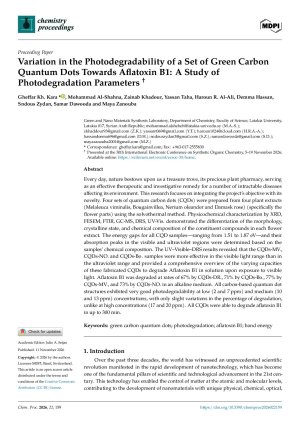
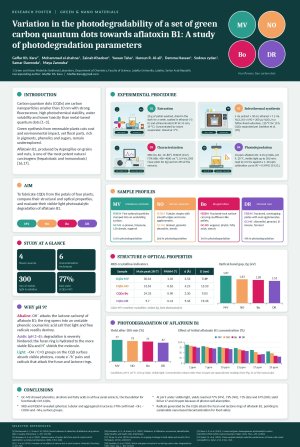
Every day, nature bestows upon us a treasure trove, its precious plant pharmacy, serving as an effective therapeutic and investigative remedy for a number of intractable diseases affecting its environment. This research focuses on integrating the project's objective with its novelty. Four sets of quantum carbon dots (CQDs) were prepared from four plant extracts (Melaleuca viminalis, Bougainvillea, Nerium oleander and Damask rose) (specifically the flower parts) using the solvothermal method. Physicochemical characterization (XRD, FESEM, FTIR, GC-MS, DRS, UV-Vis.) demonstrated the differentiation of the morphology, crystalline state, and chemical composition of the constituent compounds in each flower extract. The energy gaps of all CQDs samples in the 2-2.7 eV range and the absorption peaks, which revealed the effectiveness of the chemical components in the visible spectrum, provided a comprehensive overview of the variation in the ability of the preparef CQDs to degrade aflatoxin B on its solutions under visible light irradiation. Aflatoxin B was degraded at rates of 67% by CQDs-DR., 73% by CQDs-Bo., 77% by CQDs-MV., and 71% By CQDs-NO.in an alkaline medium. All carbon-based quantum dot structures exhibited very good photodegradability at low (2 and 7 ppm) and medium (10 and 13 ppm) concentrations, with only slight variations in the percentage of degradation, unlike at high concentrations (17 and 20 ppm). All CQDs were able to degrade aflatoxin B in up to 300 minutes.
Keywords
Green carbon quantum dots
Photodegradability
Aflatoxin B1
Band energy
Manuscript
Sciforum-202247.pdf
Poster
CQDs_Aflatoxin_B1_Poster.pdf
In Silico Design and Atom-Based 3D-QSAR Studies of Novel Flavonoid Derivatives as Potent alpha-Glucosidase Inhibitors
Click Chemistry as a Synthetic Strategy for the Preparation of Bis(indolyl)-1,2,3-triazole Analogues of Topsentin and Nortopsentin