Event submissions
EventsMOL2NET'16, Conference on Molecular, Biomed., Comput. & Network Science and Engineering, 2nd ed.
Published

This submission belongs to the session 03. USEDAT-02: USA-Europe Data Analysis Training Program Workshop, Cambridge, UK-Bilbao, Spain-Miami, USA, 2016 of the event MOL2NET'16, Conference on Molecular, Biomed., Comput. & Network Science and Engineering, 2nd ed.
Published date
06 Dec, 2016
Citation
Jesus Vicente de Julián-Ortiz, Lionello Pogliani, Emili Besalú, Artificial Neural Networks and Multilinear Least Squares to Model Physicochemical Properties of Organic Solvents, in Proceedings of MOL2NET'16, Conference on Molecular, Biomed., Comput. & Network Science and Engineering, 2nd ed., 15 October–20 October 2022, MDPI: Basel, Switzerland, doi: 10.3390/mol2net-02-03826
Share
Email
Facebook
Twitter
LinkedIn
Artificial Neural Networks and Multilinear Least Squares to Model Physicochemical Properties of Organic Solvents

Jesus Vicente de Julián-Ortiz 1
'%3e%3cpath%20d='M12.6647%2010.9104C12.4176%2010.325%2012.0589%209.7933%2011.6088%209.34485C11.16%208.89511%2010.6283%208.53653%2010.0432%208.28891C10.038%208.28629%2010.0327%208.28498%2010.0275%208.28236C10.8437%207.69282%2011.3743%206.73252%2011.3743%205.64907C11.3743%203.85423%209.92005%202.40002%208.12522%202.40002C6.33038%202.40002%204.87618%203.85423%204.87618%205.64907C4.87618%206.73252%205.40677%207.69282%206.22296%208.28367C6.21772%208.28629%206.21248%208.2876%206.20724%208.29022C5.62031%208.53783%205.09365%208.89287%204.64167%209.34616C4.19192%209.79496%203.83334%2010.3266%203.58573%2010.9117C3.34247%2011.4846%203.21128%2012.0987%203.19925%2012.721C3.1989%2012.735%203.20135%2012.7489%203.20646%2012.7619C3.21157%2012.7749%203.21924%2012.7868%203.22901%2012.7968C3.23877%2012.8068%203.25045%2012.8148%203.26334%2012.8202C3.27623%2012.8256%203.29007%2012.8284%203.30406%2012.8284H4.09012C4.14776%2012.8284%204.19362%2012.7825%204.19493%2012.7262C4.22113%2011.7148%204.62726%2010.7676%205.34519%2010.0497C6.08802%209.30686%207.07452%208.89811%208.12522%208.89811C9.17592%208.89811%2010.1624%209.30686%2010.9052%2010.0497C11.6232%2010.7676%2012.0293%2011.7148%2012.0555%2012.7262C12.0568%2012.7839%2012.1027%2012.8284%2012.1603%2012.8284H12.9464C12.9604%2012.8284%2012.9742%2012.8256%2012.9871%2012.8202C13%2012.8148%2013.0117%2012.8068%2013.0214%2012.7968C13.0312%2012.7868%2013.0389%2012.7749%2013.044%2012.7619C13.0491%2012.7489%2013.0515%2012.735%2013.0512%2012.721C13.0381%2012.0947%2012.9084%2011.4856%2012.6647%2010.9104ZM8.12522%207.90243C7.52388%207.90243%206.95792%207.66793%206.53214%207.24215C6.10636%206.81636%205.87185%206.2504%205.87185%205.64907C5.87185%205.04773%206.10636%204.48177%206.53214%204.05599C6.95792%203.63021%207.52388%203.3957%208.12522%203.3957C8.72655%203.3957%209.29252%203.63021%209.7183%204.05599C10.1441%204.48177%2010.3786%205.04773%2010.3786%205.64907C10.3786%206.2504%2010.1441%206.81636%209.7183%207.24215C9.29252%207.66793%208.72655%207.90243%208.12522%207.90243Z'%20fill='%235D1EE1'/%3e%3c/g%3e%3c/svg%3e)
Lionello Pogliani 2,3
Emili Besalú 4
1. Departament de Química Física, Universitat de València, Spain
2. Departamento de Química Física, Universidad de Valencia, Spain
3. MOLware SL, C/ Burriana 36, 3, Valencia, Spain
4. Institut de Química Computacional, Universitat de Girona, Spain
Abstract
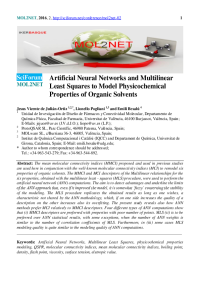
The mean molecular connectivity indices (MMCI) proposed and used in previous studies are used here in conjunction with the well-known molecular connectivity indices (MCI) to remodel six properties of organic solvents. The MMCI and MCI descriptors of the multilinear relationships for the six properties, obtained with the multilinear least - squares (MLS) procedure, were used to perform the artificial neural network (ANN) computations. The aim is to detect adavantages and underline the limits of the ANN approach that, even if it is able to refine and improve the model, it is somewhat ‘fuzzy’ concerning the stability of the modeling. The MLS procedure is able to replicate the obtaiend results as long as one wishes, a characteristic not shared by the ANN methodology, which, if on one side increases the quality of a description on the other increases also its overfitting. The present study reveals also how ANN methods prefer MCI relatively to MMCI descriptors. Four different types of ANN computations show that (i) MMCI descriptors are preferred with properties with poor number of points. MLS (ii) is to be preferred over ANN statistical results, with some exceptions, when the number of ANN weights is similar to the number of correlation coefficients of MLS. Furthermore, in (iii) some cases MLS modeling quality is quite similar to the modeling quality of ANN computations.
Keywords
Neural networks
Linear models
QSPR
Mean molecular connectivity indices
State indices
Molecular connectivity
Poster
MOL2NET-02 - Artificial Neural Networks and Multilinear Least Squares to Model Physicochemical Properties of Organic Solvents.pdf
Immunohistochemestry vs. Immunofluorescence: Comparative analysis via software of total colorimetric reaction of GPR43 protein in adipose tissue
Models of Molecular Data Integration on Cancer