Event submissions
EventsMOL2NET'16, Conference on Molecular, Biomed., Comput. & Network Science and Engineering, 2nd ed.
Published

This submission belongs to the session 01. CHEMBIOINFO-02: Chem-Bioinformatics Congress Cambridge, UK-Chapel Hill and Richmond, USA, 2016. of the event MOL2NET'16, Conference on Molecular, Biomed., Comput. & Network Science and Engineering, 2nd ed.
Published date
12 Dec, 2016
Citation
Pablo Henrique Delmondes, Ricardo Stefani, Molecular Docking Studies Of Natural Phenolic Compound and Derivates With Phospholipase A2, in Proceedings of MOL2NET'16, Conference on Molecular, Biomed., Comput. & Network Science and Engineering, 2nd ed., 15 October–20 October 2022, MDPI: Basel, Switzerland, doi: 10.3390/mol2net-02-03830
Share
Email
Facebook
Twitter
LinkedIn
Molecular Docking Studies Of Natural Phenolic Compound and Derivates With Phospholipase A2
'%3e%3cpath%20d='M12.6647%2010.9104C12.4176%2010.325%2012.0589%209.7933%2011.6088%209.34485C11.16%208.89511%2010.6283%208.53653%2010.0432%208.28891C10.038%208.28629%2010.0327%208.28498%2010.0275%208.28236C10.8437%207.69282%2011.3743%206.73252%2011.3743%205.64907C11.3743%203.85423%209.92005%202.40002%208.12522%202.40002C6.33038%202.40002%204.87618%203.85423%204.87618%205.64907C4.87618%206.73252%205.40677%207.69282%206.22296%208.28367C6.21772%208.28629%206.21248%208.2876%206.20724%208.29022C5.62031%208.53783%205.09365%208.89287%204.64167%209.34616C4.19192%209.79496%203.83334%2010.3266%203.58573%2010.9117C3.34247%2011.4846%203.21128%2012.0987%203.19925%2012.721C3.1989%2012.735%203.20135%2012.7489%203.20646%2012.7619C3.21157%2012.7749%203.21924%2012.7868%203.22901%2012.7968C3.23877%2012.8068%203.25045%2012.8148%203.26334%2012.8202C3.27623%2012.8256%203.29007%2012.8284%203.30406%2012.8284H4.09012C4.14776%2012.8284%204.19362%2012.7825%204.19493%2012.7262C4.22113%2011.7148%204.62726%2010.7676%205.34519%2010.0497C6.08802%209.30686%207.07452%208.89811%208.12522%208.89811C9.17592%208.89811%2010.1624%209.30686%2010.9052%2010.0497C11.6232%2010.7676%2012.0293%2011.7148%2012.0555%2012.7262C12.0568%2012.7839%2012.1027%2012.8284%2012.1603%2012.8284H12.9464C12.9604%2012.8284%2012.9742%2012.8256%2012.9871%2012.8202C13%2012.8148%2013.0117%2012.8068%2013.0214%2012.7968C13.0312%2012.7868%2013.0389%2012.7749%2013.044%2012.7619C13.0491%2012.7489%2013.0515%2012.735%2013.0512%2012.721C13.0381%2012.0947%2012.9084%2011.4856%2012.6647%2010.9104ZM8.12522%207.90243C7.52388%207.90243%206.95792%207.66793%206.53214%207.24215C6.10636%206.81636%205.87185%206.2504%205.87185%205.64907C5.87185%205.04773%206.10636%204.48177%206.53214%204.05599C6.95792%203.63021%207.52388%203.3957%208.12522%203.3957C8.72655%203.3957%209.29252%203.63021%209.7183%204.05599C10.1441%204.48177%2010.3786%205.04773%2010.3786%205.64907C10.3786%206.2504%2010.1441%206.81636%209.7183%207.24215C9.29252%207.66793%208.72655%207.90243%208.12522%207.90243Z'%20fill='%235D1EE1'/%3e%3c/g%3e%3c/svg%3e)
Pablo Henrique Delmondes 1
Ricardo Stefani 1
1. Laboratório de Estudos em Materiais (LEMAT), Instituto de Ciências Exatas e da Terra, Campus Universitário do Araguaia, Universidade Federal de Mato Grosso
Abstract
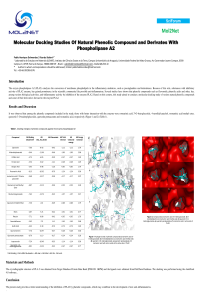
The enzym phospholipase A2 (PLA2) catalyzes the conversion of membrane phospholipids in the inflammatory mediators, such as prostaglandins and leukotrienes. Because of this role, substances with inhibitory activity of PLA2 enzyme, has gained prominence in the scientific community like possible anti-inflammatory. Several studies have shown that phenolic compounds such as flavonoids, phenolic acids and other, has, among various biological activities, anti-inflammatory activity by inhibition of the enzyme PLA2. Based on this context, this study aimed to conduct a molecular docking study of various natural phenolic compounds and some of their derivatives forward to the enzyme PLA2. The crystallographic structure of PLA 2 was obtained from Target Database Protein Data Bank [PDB ID: 1KPM] and the ligands were obtained from PubChem Database. The docking was performed using the AutoDock 4.0 software. It was observed that among the phenolic compounds included in the study, those with better interaction with the enzyme were rosmarinic acid 3'-O-beta-glucoside, 4-nerolidylcatechol, rosmarinic acid methyl ester, quercetin 3-O-malonylglucoside, quercetin pentaacetate and rosmarinic acid, respectively. The present study provides a better understanding of the inhibition of PLA2 by phenolic compounds, which may contribute to the development of new anti-inflammatories.
Keywords
Poster
poster.pdf
Machine-Learning models to predict the antioxidant capacity of food
An approach to Trypanosoma cruzi Vaccine through the epitope prediction from proteins surface with IEDB