Event submissions
Published
This submission belongs to the session 4. Biodiversity Conservation at Botanical Gardens of the event The 1st International Online Conference on Zoological and Botanical Gardens
Published date
27 Nov, 2026
Academic Editor
 Jože Bavcon
Contribution&Funding
Conceptualization,
[Mykhailo Zhurba]
Methodology,
[Zuzana Kňažická] ; [Olga Grygorieva] ; [Katarina Fatrcová Šramková] ; [Ivan Gurnenko]
Software,
[Zuzana Kňažická] ; [Olga Grygorieva] ; [Ivan Gurnenko]
Validation,
[Mykhailo Zhurba]
Formal analysis,
[Katarina Fatrcová Šramková]
Resources,
[Vladimíra Bella] ; [Mykhailo Zhurba]
Data curation,
[Vladimíra Bella] ; [Olga Grygorieva] ; [Katarina Fatrcová Šramková] ; [Zuzana Kňažická]
Visualization,
[Mykhailo Zhurba]
Funding: --
Citation
Mykhailo Zhurba, Olga Grygorieva, Ivan Gurnenko, Vladimíra Bella, Katarina Fatrcová Šramková, Zuzana Kňažická, Comparative Pollen Morphology of Introduced Lycium Species in the Collection of the M.M. Gryshko National Botanical Garden, in Proceedings of The 1st International Online Conference on Zoological and Botanical Gardens, 2 December–4 December 2026, MDPI: Basel, Switzerland
Share
Email
Facebook
Twitter
LinkedIn
Comparative Pollen Morphology of Introduced Lycium Species in the Collection of the M.M. Gryshko National Botanical Garden

Mykhailo Zhurba 1

Olga Grygorieva 1
Ivan Gurnenko 2
Vladimíra Bella 3
Katarina Fatrcová Šramková 4
Zuzana Kňažická 4
1. Department of Fruit Plants Acclimatization, M.M. Gryshko National Botanical Garden of the National Academy of Sciences of Ukraine, Kyiv, 01014, Ukraine
2. Department of Tropical and Subtropical Plants, M.M. Gryshko National Botanical Garden of the National Academy of Sciences of Ukraine, Kyiv, 01014, Ukraine
3. AgroBioTech Research Centre, Slovak University of Agriculture in Nitra, Nitra, Slovakia
4. Institute of Nutrition and Genomics, Faculty of Agrobiology and Food Resources, Slovak University of Agriculture in Nitra, Nitra, Slovakia
Abstract
Botanical Gardens provide valuable opportunities for the scientific evaluation of introduced plant species. Although species of the genus Lycium L. are increasingly cultivated for their nutritional, medicinal, and ornamental value, comparative palynological data remain limited. Therefore, this study aimed to compare the pollen morphology of three introduced Lycium species maintained in the collection of the M.M. Gryshko National Botanical Garden.
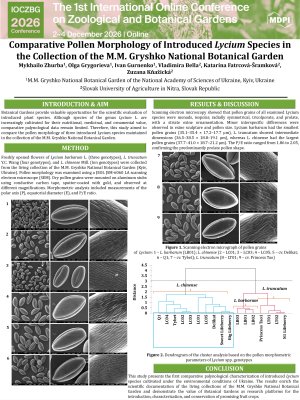
Freshly opened flowers of Lycium barbarum L. (three genotypes), L. truncatum Y.C. Wang (four genotypes), and L. chinense Mill. (ten genotypes) were collected from the living collection of the M.M. Gryshko National Botanical Garden of the National Academy of Sciences of Ukraine (Kyiv, Ukraine). Pollen morphology was examined using a JEOL JSM-6060 LA scanning electron microscope (SEM). Dry pollen grains were mounted on aluminum stubs using conductive carbon tape, sputter-coated with gold, and observed at different magnifications. Morphometric analysis included measurements of the polar axis (P), equatorial diameter (E), and P/E ratio.
Scanning electron microscopy showed that pollen grains of all examined Lycium species were monads, isopolar, radially symmetrical, tricolporate, and prolate, with a striate exine ornamentation. Minor interspecific differences were observed in exine sculpture and pollen size. Lycium barbarum had the smallest pollen grains (35.1–35.4 × 17.2–17.7 μm), L. truncatum showed intermediate dimensions (36.5–38.5 × 18.8–19.1 μm), whereas L. chinense had the largest pollen grains (37.7–41.0 × 18.7–21.2 μm). The P/E ratio ranged from 1.86 to 2.05, confirming the predominantly prolate pollen shape.
This study presents the first comparative palynological characterization of introduced Lycium species cultivated under the environmental conditions of Ukraine. The results enrich the scientific documentation of the living collections of the M.M. Gryshko National Botanical Garden and demonstrate the value of Botanical Gardens as research platforms for the introduction, characterization, and conservation of promising fruit crops.
Keywords
Lycium; pollen morphology; scanning electron microscopy; introduced species
Poster
Lycium .pdf
Genotype variation of Lavandula angustifolia Mill. and Lavandula × intermedia Emeric ex Loisel. on polyphenol content and antioxidant activity
Palynological Characterization of ×Sorbaronia fallax nothosubsp. mitschurinii Genotypes Maintained in the Collection of the M.M. Gryshko National Botanical Garden